
Crime crackdown promotes stability: top judge
时间:2007-03-14 03:23:55
(单词翻译:单击)
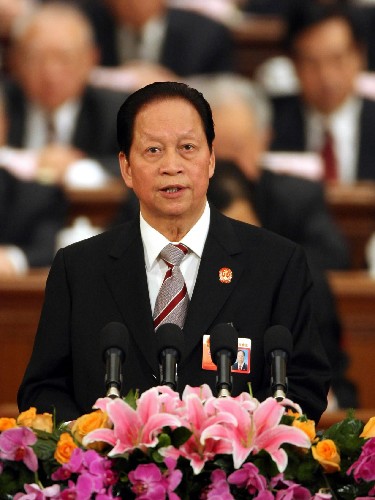
| President of China's Supreme1 People's Court, Xiao Yang, delivers a report on judicial2 work at the annual full session of the National People's Congress, China's top legislature in the Great Hall of the People in downtown Beijing on Tuesday, March 13, 2007. [Photo: Xinhua] |
| Mar3.14 - China's chief justice said in Beijing on Tuesday that the efforts of Chinese courts in 2006 to crack down on criminal activities of various kinds helped safeguard national security and social stability, and promoted human rights protection.
In 2006, China's Supreme People's Court (SPC) handled a total of 3,668 cases involving a variety of crimes, up 14.77 percent over the previous year, said SPC President Xiao Yang in a report on the judicial work, delivered to the national legislature for examination. Local courts at all levels heard and concluded 8,105,007 cases in 2006, an increase of 2.07 percent year on year. Of the total, 2,323 case involved state compensation amounting to 34.84 million yuan (4.47 million U.S. dollars), said Xiao. Courts across the country in 2006 tried and concluded 245,254 criminal cases involving felonies like explosion, murder, robbery, rape4 and kidnapping, and sentenced 340,715 criminals convicted in such cases. According to the top judge, Chinese judges in the past year also handled 23,733 cases of embezzlement5, bribery6 and dereliction of duty, sentencing 825 convicted government officials above the county level, including 9 provincial- and ministerial-level officials. Corruption7 and commercial bribery have become a prominent social problem in China, arousing public anger and leading to the downfall of a number of high-ranking officials, including former head of National Statistics Bureau Qiu Xiaohua and former director of State Food and Drug Administration Zheng Xiaoyu. Chen Liangyu, former Party chief of Shanghai, China's economic center, was also put under investigation8 for his involvement in a major social security fund scandal, in which 3.7 billion yuan (475 million U.S. dollars) of the fund was found to be misused9. Courts across the country in 2006 also tried and concluded 31,582 cases involving the manufacture, trafficking and sale of narcotics10, sentencing 37,256 criminals convicted in such cases. In the area of intellectual property rights protection, Xiao said that Chinese courts concluded 17,769 cases involving intellectual property rights infringement11 in 2006, with 3,508 people convicted and sentenced. "Among all criminals convicted in 2006, 153,724 received sentences from five years and above in prison to life imprisonment12 and death penalty," he told the nearly 3,000 lawmakers attending the annual full session of the National People's Congress. Xiao said that Chinese courts at all levels, in their efforts to respect and safeguard human rights, pronounced 1,713 criminal defendants13 innocent in 2006, following the principle of meting14 out penalty to the guilty and setting the innocent free in time in accordance with the law. Experiment on granting relief fund to victims of criminal cases and their relatives went on smoothly15, he said. Statistics from the 10 higher people's courts carrying out the pilot program showed they in total issued 7.80 million yuan in the relief fund to 378 victims of criminal cases and their relatives in 2006. One of the major developments in the field of human rights protection lies in the reform of the mechanism16 to decide on death penalties. Xiao said the supreme court took back the power to review and ratify17 all death penalty cases as of Jan. 1, 2007, ending a 26-year practice of letting courts at lower levels decide on part of such cases. To make lawsuits18 affordable19 to all people, Chinese courts have provided timely judicial assistance to litigants20 with financial difficulties, Xiao said. As a result, 282,582 people were allowed to delay or reduce the payment of court costs, or even totally exempted21 from the costs in 2006, with a total of 1.2 billion yuan spared for them, he noted22. The top judge also reported a 4.71 percent drop in the number of letters, visits and calls of complaints and petitions the supreme court received from the general public in 2006 compared to the previous year. The supreme court received 140,511 such letters, visits and calls in the year. Meanwhile, local courts across the country received 3,548,504 such letters, visits and calls, a decrease of 11.18 percent year on year. The supreme court also intensified23 its efforts to fight corruption among judges and promote judicial justice, said the top judge. "A total of 292 judges were found to have abused power for personal interests in 2006, and 109 of them were given criminal penalty according to law," he said. In 2006, Chinese courts at all levels handled 7,375 maritime24 cases involving 4.445 billion yuan, giving equal protection to the legitimate25 rights and interests of Chinese and foreign nationals involved, said the SPC president. The courts also concluded 23,313 cases involving foreign nationals and residents of Hong Kong, Macao and Taiwan in 2006, an increase of 16.39 percent year on year, he added. Apart from the courts' achievements, the top judge also raked up problems pestering26 the country's judicial work, such as unfair judgment27 and failure in providing timely protection to the legitimate rights and interests of some litigants who had won their lawsuits. He attributed the problems to the poor capability28 of some judges, a lack of professional ethics29 among some others, and the "malpractice of a small handful of judges and senior court officials". "We will take even stronger measures to make improvement" and "guarantee the power of judgment is exercised correctly", said Xiao,adding that the supreme court will strive to ensure the legitimate rights and interests of all litigants are well protected and the professional quality of Chinese judges as a whole improved substantially.
|
点击 收听单词发音
收听单词发音 |
1
supreme
|
|
| adj.极度的,最重要的;至高的,最高的 | |
参考例句: |
|
|
|
|
2
judicial
|
|
| adj.司法的,法庭的,审判的,明断的,公正的 | |
参考例句: |
|
|
|
|
3
mar
|
|
| vt.破坏,毁坏,弄糟 | |
参考例句: |
|
|
|
|
4
rape
|
|
| n.抢夺,掠夺,强奸;vt.掠夺,抢夺,强奸 | |
参考例句: |
|
|
|
|
5
embezzlement
|
|
| n.盗用,贪污 | |
参考例句: |
|
|
|
|
6
bribery
|
|
| n.贿络行为,行贿,受贿 | |
参考例句: |
|
|
|
|
7
corruption
|
|
| n.腐败,堕落,贪污 | |
参考例句: |
|
|
|
|
8
investigation
|
|
| n.调查,调查研究 | |
参考例句: |
|
|
|
|
9
misused
|
|
| v.使用…不当( misuse的过去式和过去分词 );把…派作不正当的用途;虐待;滥用 | |
参考例句: |
|
|
|
|
10
narcotics
|
|
| n.麻醉药( narcotic的名词复数 );毒品;毒 | |
参考例句: |
|
|
|
|
11
infringement
|
|
| n.违反;侵权 | |
参考例句: |
|
|
|
|
12
imprisonment
|
|
| n.关押,监禁,坐牢 | |
参考例句: |
|
|
|
|
13
defendants
|
|
| 被告( defendant的名词复数 ) | |
参考例句: |
|
|
|
|
14
meting
|
|
| v.(对某人)施以,给予(处罚等)( mete的现在分词 ) | |
参考例句: |
|
|
|
|
15
smoothly
|
|
| adv.平滑地,顺利地,流利地,流畅地 | |
参考例句: |
|
|
|
|
16
mechanism
|
|
| n.机械装置;机构,结构 | |
参考例句: |
|
|
|
|
17
ratify
|
|
| v.批准,认可,追认 | |
参考例句: |
|
|
|
|
18
lawsuits
|
|
| n.诉讼( lawsuit的名词复数 ) | |
参考例句: |
|
|
|
|
19
affordable
|
|
| adj.支付得起的,不太昂贵的 | |
参考例句: |
|
|
|
|
20
litigants
|
|
| n.诉讼当事人( litigant的名词复数 ) | |
参考例句: |
|
|
|
|
21
exempted
|
|
| 使免除[豁免]( exempt的过去式和过去分词 ) | |
参考例句: |
|
|
|
|
22
noted
|
|
| adj.著名的,知名的 | |
参考例句: |
|
|
|
|
23
intensified
|
|
| v.(使)增强, (使)加剧( intensify的过去式和过去分词 ) | |
参考例句: |
|
|
|
|
24
maritime
|
|
| adj.海的,海事的,航海的,近海的,沿海的 | |
参考例句: |
|
|
|
|
25
legitimate
|
|
| adj.合法的,合理的,合乎逻辑的;v.使合法 | |
参考例句: |
|
|
|
|
26
pestering
|
|
| 使烦恼,纠缠( pester的现在分词 ) | |
参考例句: |
|
|
|
|
27
judgment
|
|
| n.审判;判断力,识别力,看法,意见 | |
参考例句: |
|
|
|
|
28
capability
|
|
| n.能力;才能;(pl)可发展的能力或特性等 | |
参考例句: |
|
|
|
|
29
ethics
|
|
| n.伦理学;伦理观,道德标准 | |
参考例句: |
|
|
|


©2005-2010英文阅读网