
Abe urged to keep his word, mend ties
时间:2006-09-22 02:08:29
(单词翻译:单击)
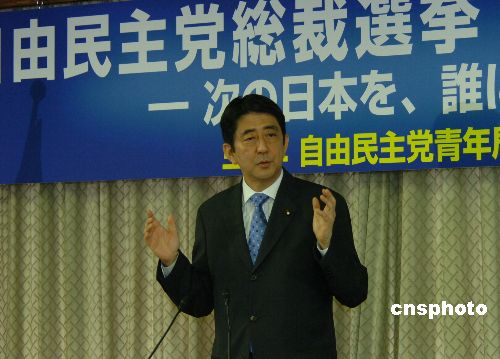
| Newly elected Japanese ruling Liberal Democratic Party (LDP) President Shinzo Abe.(File Photo) |
| Sept. 21 - China expressed hope yesterday that the newly-elected president of Japan's ruling party will "make sincere efforts" to improve Sino-Japanese relations.
Shinzo Abe, who received an overwhelming 464 votes out of 703, was elected the 21st chief of the Liberal Democratic Party earlier yesterday. "We hope the new LDP leader can match his words with action and make sincere efforts for the improvement of bilateral1 relations," said Foreign Ministry2 spokesman Qin Gang. Abe who has repeatedly declared that he seeks better ties with China is set to succeed Junichiro Koizumi as Japan's prime minister next Tuesday, given the LDP's majority in the House of Representatives which has the final say in the choice. He has defended Koizumi's pilgrimages to the Yasukuni Shrine3, where Japan's war dead, including World War II criminals are honoured; and refused to say whether he would visit the shrine as prime minister. "The key to solving the present difficulties is for the Japanese leader to make an early resolution on removing the political barrier of the shrine visits, and bringing bilateral relations back on to the normal track," Qin told a regular news briefing on Tuesday. Judging from Abe's political record and his words and actions while serving as chief cabinet secretary in the cabinet of the outgoing prime minister, it is hard to expect breakthroughs in the settlement of disputes between the two nations, said Zheng Donghui, a researcher on Japan at the China Institute of International Studies. The son of a foreign minister and grandson of a prime minister, Abe has positioned himself as a hawkish4 politician. Pacifists say Abe is a nationalist who will push for a militarized Japan, while supporters claim he just wants a stronger foreign policy. "Anyway, he can't avoid the problem of the Yakusuni Shrine, on which he has to make a wise political decision if he wants to improve Sino-Japanese relations," Zheng said. China has refused to hold a summit with Koizumi because of his repeated visits to the shrine, seen by China and many other Asian countries as a symbol of Japan's past militarism. In fact, Zheng said, it was Koizumi who created the stalemate because of his obstinate5 persistence6 in visiting the shrine. The Republic of Korea also expressed hope yesterday that its relations with Japan would improve by the removal of conflicts caused by Japanese leaders' visits to the shrine.
|
点击 收听单词发音
收听单词发音 |
1
bilateral
|
|
| adj.双方的,两边的,两侧的 | |
参考例句: |
|
|
|
|
2
ministry
|
|
| n.(政府的)部;牧师 | |
参考例句: |
|
|
|
|
3
shrine
|
|
| n.圣地,神龛,庙;v.将...置于神龛内,把...奉为神圣 | |
参考例句: |
|
|
|
|
4
hawkish
|
|
| adj. 鹰派的, 强硬派的 | |
参考例句: |
|
|
|
|
5
obstinate
|
|
| adj.顽固的,倔强的,不易屈服的,较难治愈的 | |
参考例句: |
|
|
|
|
6
persistence
|
|
| n.坚持,持续,存留 | |
参考例句: |
|
|
|


©2005-2010英文阅读网