
Abe ready for China summit any time
时间:2006-09-30 06:56:53
(单词翻译:单击)
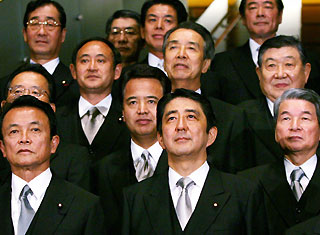
| Newly-elected Japanese Prime Minister Shinzo Abe (C) poses with his Foreign Minister Taro1 Aso (L) and other cabinet members during an official group photo at the premier2's official residence in Tokyo September 26, 2006. [Reuters] |
| Sept. 28 - Japanese Prime Minister Shinzo Abe is ready for top-level talks with China, his spokesman said on the leader's first full day in office yesterday.
Abe is willing to meet Chinese or South Korean leaders at any time to try to resolve issues of concern, including territorial3 disputes and regional anger over official visits to a controversial Tokyo war shrine4, said newly appointed Chief Cabinet Secretary Yasuhisa Shiozaki. "We both share an understanding that we should work to hold top-level talks as early as possible," Shiozaki said. "It is necessary for both sides to make an effort." He said no specific plans have been made for talks yet. Since last year, President Hu Jintao has refused to meet Abe's predecessor5, Junichiro Koizumi, because of his repeated visits to the Yasukuni war shrine, which honours war criminals among Japan's war dead. Both China and South Korea say the shrine glorifies6 Japan's past militarism. On Tuesday, Premier Wen Jiabao sent a congratulatory message to Abe on his inauguration7 as prime minister and described China-Japan relations as being in an "important historical period." "To continuously develop the neighbourly, friendly and co-operative relationship not only conforms to the common interests of the two countries and the two peoples, but also benefits peace, stability and prosperity in the Asia-Pacific region, as well as the world," he said. "I am willing to work together with you [Abe] to make unremitting efforts" to push forward the development of China-Japan relations, Wen added. In Seoul, the South Korean government yesterday said that "sincere and vigorous" efforts should be made by Japan to mend strained ties between the two countries. "There is a demand for the two nations to work together for not only the development of their relations, but also regional stability and prosperity," Vice-Foreign Minister Lee Kyu-hyung told a press briefing. According to local media, South Korean Foreign Minister Ban Ki- moon earlier called on Abe not to follow in the footsteps of his predecessor Junichiro Koizumi. "We sincerely hope that Prime Minister Abe will learn lessons from what has transpired8 during Prime Minister Koizumi's administration," Ban said in an interview with Japan's Kyodo news agency in New York.
|
点击 收听单词发音
收听单词发音 |
1
taro
|
|
| n.芋,芋头 | |
参考例句: |
|
|
|
|
2
premier
|
|
| adj.首要的;n.总理,首相 | |
参考例句: |
|
|
|
|
3
territorial
|
|
| adj.领土的,领地的 | |
参考例句: |
|
|
|
|
4
shrine
|
|
| n.圣地,神龛,庙;v.将...置于神龛内,把...奉为神圣 | |
参考例句: |
|
|
|
|
5
predecessor
|
|
| n.前辈,前任 | |
参考例句: |
|
|
|
|
6
glorifies
|
|
| 赞美( glorify的第三人称单数 ); 颂扬; 美化; 使光荣 | |
参考例句: |
|
|
|
|
7
inauguration
|
|
| n.开幕、就职典礼 | |
参考例句: |
|
|
|
|
8
transpired
|
|
| (事实,秘密等)被人知道( transpire的过去式和过去分词 ); 泄露; 显露; 发生 | |
参考例句: |
|
|
|


©2005-2010英文阅读网