
I. M. Pei in China, revisiting roots
(单词翻译:单击)
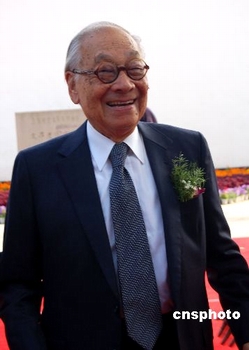
| “I’ve never done anything like this before,” said Mr. Pei, the 89-year-old architect, who was nursing a cold and sipping1 from a cup of hot water. “I’ve used gray and white, which are Suzhou colors. But the form is modern.” |
| Oct. 9 - For I. M. Pei, the sprawling2 white stucco museum that opened to great fanfare3 here this weekend is both a possible swan song and a second chance.
The only other building he has ever designed in mainland China, a luxury hotel completed in Beijing in 1982, was a disappointment that he says was rescued only by its beautiful setting in the woods. “I was saved by the trees,” he said ruefully in an interview Saturday afternoon. This time Mr. Pei believes he has succeeded, he said. Returning to his ancestral home 100 miles northwest of Shanghai, he has designed a $40 million building that he hopes will help point the way toward a new type of architecture in the world’s fastest-growing economy, a building that is Chinese in spirit yet ultimately modern. “I’ve never done anything like this before,” said Mr. Pei, the 89-year-old architect, who was nursing a cold and sipping from a cup of hot water. “I’ve used gray and white, which are Suzhou colors. But the form is modern.” Since retiring in 1990 from his New York firm, Mr. Pei has traveled the world, putting his bright, geometric imprints4 on buildings in London, Luxembourg, Japan and the Middle East. The Suzhou Museum is uniquely personal for him, he said. Although Mr. Pei was born south of here, in Guangzhou, and grew up mostly in Hong Kong and Shanghai, his forebears lived in Suzhou for hundreds of years. And he spent several memorable5 summers here as a youth. “My grandfather had a house and a garden here,” he said. “I was one of the older grandsons. I should learn about the family business. So I came here three summers. I remember it well.” Mr. Pei’s father was a prominent banker, serving at one time as governor of the country’s central bank. Mr. Pei himself left China in 1935 to study architecture at the Massachusetts Institute of Technology and then Harvard. He did not return for nearly 40 years, when he led a group of American architects on a visit in 1974. Later, at the behest of the Chinese government, he returned again to design the luxury hotel in Beijing, in the Fragrant6 Hills park sector7. He said the project was fraught8 with delays and obstacles, including a shortage of quality materials. “It was an experience that discouraged me a lot about China,” he says. “I didn’t think China had a future. The young people didn’t work. They just slept on the job.” Yet four years ago, when he was asked by the Suzhou government to build a large museum on hallowed ground adjoining a complex of 19th-century historical structures and two gardens listed as Unesco World Heritage sites, Mr. Pei did not hesitate. “I had roots here, and I felt I hadn’t done right,” he said, referring to the Fragrant Hills project. “I wanted to make amends9, or to do something that will have a greater impact on architecture.” There were challenges. The museum would sit in the city’s historic district, and some traditional houses would have to be moved or destroyed to make way for it, prompting complaints from residents. |
Mr. Pei toiled10 over design concepts that might blend East and West while avoiding some of the failures of the Fragrant Hills project, which was also a mix. He sought to remain true to China’s tradition of courtyards and gardens yet rethink those models. He wanted neither a flat Western roof nor the arched gray tile roof typical of Suzhou.
He found a solution that incorporated the idea of whitewashed11 walls but eliminated the gray tile roofs, accenting the building instead with gray stone.
“Instead of gray tile roofs, I needed something that would develop volumes,” he said, drawing a diagram on a paper showing an ascending12 roof pattern. “So I let the walls climb onto the roof. If the walls were stucco, why not the roof?”
The result is a 160,000-square-foot museum that has many of the hallmarks of Mr. Pei’s earlier designs — his squares, rectangles and pyramids — as well as an expansive use of glass and light. It also has traditional motifs13, like a large Chinese garden with an artificial pond, a Chinese footbridge and a wall of thinly sliced rocks that yields an image of a series of mountain peaks against an older, whitewashed garden wall.
The timing14 of the opening was ideal, coinciding with the Mid-Autumn Festival, when the Chinese return home to pay homage15 to their ancestors and to snack on “moon cakes.” To celebrate the opening Mr. Pei invited more than 100 relatives and close friends from around the world, including friends from the art and music worlds. On Friday evening the Suzhou government gave a party for Mr. Pei with a show of traditional Chinese art and music, and on Saturday Mr. Pei held his own private party, a night of music, dance and fireworks.
Suzhou was a major cultural center during the Ming and Qing dynasties, and the museum houses relics16 from those periods, including jade17, porcelain18, calligraphy19 and paintings. Also on view is a special exhibition of works by three contemporary artists, Xu Bing, Cai Guoqiang and Zhao Wuji, all of whom left China to study or create away from home, just as Mr. Pei did.
Since he left his architectural practice in 1990, Mr. Pei said, he has accepted only commissions outside the United States, largely because of his experience in designing the addition to the Louvre in Paris, with its famed glass pyramid. “That project taught me that to know a country you have to work there on a project of consequence,” he said. “So after that project I told myself, ‘Let’s learn about the world.’ ”
With his Suzhou Museum design, Mr. Pei said, he hopes to encourage and even inspire China, which is in the midst of a frantic20 building boom, to consider its own rich traditions, to be neither a slave to the past nor an weak imitator of the West.
Looking out from the 48th-floor lounge in the Shangri-La Hotel toward a series of huge real estate projects — row after row of what might be considered Chinese versions of Levittown — Mr. Pei said: “Terrible things are happening. I can’t stop it. I can’t stop progress. But I hope it will be temporary.”
He said he hoped that in time the country would find its own path.
In China, “architecture and the garden are one,” he said. “A Western building is a building, and a garden is a garden. They’re related in spirit. But they are one in China.”
As for whether the museum is his final project, Mr. Pei said: “Never predict the future. If you ask my wife, she’ll say that’s it. But if you ask me, I’m not sure it’s the end. There are always challenges in life.”
 收听单词发音
 |
1
sipping
|
|
| v.小口喝,呷,抿( sip的现在分词 ) | |
参考例句: |
|
|
|
|
2
sprawling
|
|
| adj.蔓生的,不规则地伸展的v.伸开四肢坐[躺]( sprawl的现在分词 );蔓延;杂乱无序地拓展;四肢伸展坐着(或躺着) | |
参考例句: |
|
|
|
|
3
fanfare
|
|
| n.喇叭;号角之声;v.热闹地宣布 | |
参考例句: |
|
|
|
|
4
imprints
|
|
| n.压印( imprint的名词复数 );痕迹;持久影响 | |
参考例句: |
|
|
|
|
5
memorable
|
|
| adj.值得回忆的,难忘的,特别的,显著的 | |
参考例句: |
|
|
|
|
6
fragrant
|
|
| adj.芬香的,馥郁的,愉快的 | |
参考例句: |
|
|
|
|
7
sector
|
|
| n.部门,部分;防御地段,防区;扇形 | |
参考例句: |
|
|
|
|
8
fraught
|
|
| adj.充满…的,伴有(危险等)的;忧虑的 | |
参考例句: |
|
|
|
|
9
amends
|
|
| n. 赔偿 | |
参考例句: |
|
|
|
|
10
toiled
|
|
| 长时间或辛苦地工作( toil的过去式和过去分词 ); 艰难缓慢地移动,跋涉 | |
参考例句: |
|
|
|
|
11
whitewashed
|
|
| 粉饰,美化,掩饰( whitewash的过去式和过去分词 ) | |
参考例句: |
|
|
|
|
12
ascending
|
|
| adj.上升的,向上的 | |
参考例句: |
|
|
|
|
13
motifs
|
|
| n. (文艺作品等的)主题( motif的名词复数 );中心思想;基本模式;基本图案 | |
参考例句: |
|
|
|
|
14
timing
|
|
| n.时间安排,时间选择 | |
参考例句: |
|
|
|
|
15
homage
|
|
| n.尊敬,敬意,崇敬 | |
参考例句: |
|
|
|
|
16
relics
|
|
| [pl.]n.遗物,遗迹,遗产;遗体,尸骸 | |
参考例句: |
|
|
|
|
17
jade
|
|
| n.玉石;碧玉;翡翠 | |
参考例句: |
|
|
|
|
18
porcelain
|
|
| n.瓷;adj.瓷的,瓷制的 | |
参考例句: |
|
|
|
|
19
calligraphy
|
|
| n.书法 | |
参考例句: |
|
|
|
|
20
frantic
|
|
| adj.狂乱的,错乱的,激昂的 | |
参考例句: |
|
|
|


