
Security Council OKs N. Korea sanctions
时间:2006-10-16 06:25:47
(单词翻译:单击)
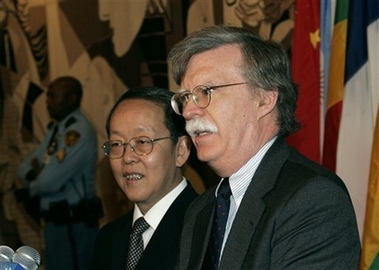
| Wang Guangya (L), China's ambassador to the United Nations and John Bolton, the U.S. ambassador to the U.N. announce to reporters that an agreement has been reached before a Security Council vote on North Korea at U.N. headquarters Saturday, Oct. 14, 2006. (Photo: AP) |
| Oct. 15 - The U.N. Security Council voted unanimously on Saturday to impose punishing sanctions on North Korea including ship searches for banned weapons, calling Pyongyang's claimed nuclear test "a clear threat to international peace and security."
North Korea immediately rejected the resolution, and its U.N. ambassador walked out of the council chamber1 after accusing its members of a "gangster-like" action which neglects the nuclear threat posed by the United States. The U.S.-sponsored resolution demands that the reclusive communist nation abandon its nuclear weapons program, and orders all countries to prevent North Korea from importing or exporting any material for weapons of mass destruction or ballistic missiles. It orders nations to freeze assets of people or businesses connected to these programs, and ban the individuals from traveling. The resolution also calls on all countries to inspect cargo2 leaving and arriving in North Korea to prevent any illegal trafficking in unconventional weapons or ballistic missiles. The final draft was softened3 from language authorizing4 searches, but was still unacceptable to China — the North's closest ally and largest trading partner — which said it would not carry out any searches. North Korea's U.N. Ambassador Pak Gil Yon countered by blaming the United States for forcing the country to conduct a test because of its "nuclear threat, sanctions and pressure." "The Democratic People's Republic of Korea is ready for talks, dialogue and confrontation," Pak said. "If the United States increases pressure upon the Democratic People's Republic of Korea persistently5, the DPRK will continue to take physical countermeasures considering it as a declaration of war." North Korea has made similar threats in the past, and has also said it might conduct a second nuclear test in response to U.N. sanctions. The vote came after the United States, Britain and France overcame last-minute differences with Russia and China during what the Russian ambassador called "tense negotiations6." The resolution demands North Korea eliminate all its nuclear weapons but expressly rules out military action against the country, a demand by the Russians and Chinese. Bolton warned Pyongyang, however, that if it continues pursuing nuclear weapons, the U.S. would seek further measures. The Security Council condemned7 the nuclear test that North Korea said it conducted on Oct. 9. It demanded that North Korea immediately return to six-nation talks aimed at persuading Pyongyang to dismantle8 its weapons program without precondition. It also imposed sanctions for the North's "flagrant disregard" of the council's appeal not to detonate a nuclear device and demanded that North Korea "not conduct any further nuclear test or launch of a ballistic missile." "This action by the United Nations, which was swift and tough, says that we are united in our determination to see to it that the Korean peninsula is nuclear-weapons free," President Bush said. South Korea's Foreign Minister Ban Ki-moon, who was chosen on Friday to become the next U.N. secretary-general, said that the council's resolution "sends a very strong, clear and unified9 message to North Korea." "I hope that North Korea will comply with this resolution," he said. "I hope that all member states of the United Nations will fully10 implement11 this resolution." Japanese Prime Minister Shinzo Abe said Japan was considering additional sanctions against North Korea in line with the resolution, following its move Friday to ban trade with the North and close its ports to North Korean ships. "We were able to send a strong message that the international community will not tolerate North Korea's owning nuclear weapons," Abe told reporters Sunday. In a measure aimed at North Korea's tiny elite12, the resolution also bans the sale of luxury goods to the country.
|
点击 收听单词发音
收听单词发音 |
1
chamber
|
|
| n.房间,寝室;会议厅;议院;会所 | |
参考例句: |
|
|
|
|
2
cargo
|
|
| n.(一只船或一架飞机运载的)货物 | |
参考例句: |
|
|
|
|
3
softened
|
|
| (使)变软( soften的过去式和过去分词 ); 缓解打击; 缓和; 安慰 | |
参考例句: |
|
|
|
|
4
authorizing
|
|
| 授权,批准,委托( authorize的现在分词 ) | |
参考例句: |
|
|
|
|
5
persistently
|
|
| ad.坚持地;固执地 | |
参考例句: |
|
|
|
|
6
negotiations
|
|
| 协商( negotiation的名词复数 ); 谈判; 完成(难事); 通过 | |
参考例句: |
|
|
|
|
7
condemned
|
|
| adj. 被责难的, 被宣告有罪的 动词condemn的过去式和过去分词 | |
参考例句: |
|
|
|
|
8
dismantle
|
|
| vt.拆开,拆卸;废除,取消 | |
参考例句: |
|
|
|
|
9
unified
|
|
| (unify 的过去式和过去分词); 统一的; 统一标准的; 一元化的 | |
参考例句: |
|
|
|
|
10
fully
|
|
| adv.完全地,全部地,彻底地;充分地 | |
参考例句: |
|
|
|
|
11
implement
|
|
| n.(pl.)工具,器具;vt.实行,实施,执行 | |
参考例句: |
|
|
|
|
12
elite
|
|
| n.精英阶层;实力集团;adj.杰出的,卓越的 | |
参考例句: |
|
|
|


©2005-2010英文阅读网