
70th anniversary of Long March commemorated
时间:2006-10-23 01:58:52
(单词翻译:单击)
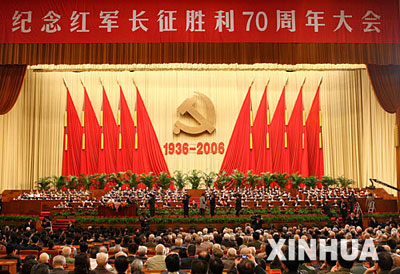
| The grand ceremony in memory of the 70th anniversary of the victory of the Long March is held in Beijing, Oct. 22, 2006. The Long March was a famous military maneuver1 carried out by the Workers' and Peasants' Red Army from 1934 to 1936 led by the Communist Party of China to combat the Kuomintang Regime. |
| BEIJING, Oct. 22 - Chinese President Hu Jintao and other top leaders attended a grand ceremony Sunday in Beijing in memory of the 70th anniversary of the victory of the Long March.
Hu Jintao, Jiang Zemin, Wu Bangguo, Wen Jiabao, Zeng Qinghong, Huang Ju, Wu Guanzheng, Li Changchun and Luo Gan attended the official memorial service. Hu said in a key-note speech that the Long March, which opened a bright future for China's revolution and laid an important foundation for the victory of China's revolution, has been a "pride" for the Chinese Communists, the Chinese army and the Chinese nation as a whole. The aim of the grand ceremony, he said, is to encourage the whole Party, the army and people of all ethnic2 groups of China, to advance valiantly3 along the socialist4 road with Chinese characteristics. Wu Bangguo, member of the Standing5 Committee of the Political Bureau of the Central Committee of the Communist Party of China and chairman of the Standing Committee of the National People's Congress, presided over the ceremony. The ceremony was broadcast live by China National Radio, China Central Television and China Radio International, as well as Xinhuanet.Com and People.Com.Cn, the official Websites of Xinhua News Agency and People's Daily. The Long March was a famous military maneuver carried out by the Workers' and Peasants' Red Army from 1934 to 1936 led by the CPC to combat the Kuomintang Regime. Though many soldiers died on the way, the Red Army finally arrived at Yan'an in western Shaanxi Province after the 25,000-li (12,500-kilometer) trek6, where the new headquarters of CPC was later established. In his speech, Hu recalled the history of the Long March, calling it a rarely-seen expedition in the history of human warfare7, referring to the long time it took, the long route it traveled, the great disparity of force between the Red Army and enemy troops it witnessed, and the abominable8 natural conditions it experienced. The victory of the Long March shows the outstanding capabilities9 of the Chinese Communists in leading the revolutionary war, the undaunted spirit of the Red Army officers and soldiers who had sacrificed their lives for national independence and people's emancipation10, and the fact that the just power of the people's revolutionary war is unbeatable, Hu said. He said the Red Army's Long March is a "great turning point" for the Chinese Revolution to go from defeat to victory, which ushered11 in the new dawn and opened up a bright future for the Party to unite and lead the people to beat the Japanese Militaristic Aggressors and strive for building a new country being independent, free, democratic, united and prosperous. Long March is of great and profound significance to the development of the Party, the Army and the Chinese Nation, said the president. Since the victory of the Long March 70 years ago, the Party has united and led the people of all ethnic groups to carry out great new "Long Marches", one after another, and achieved great victories during the different historic periods of revolution, construction and reform, he said. Hu pledged to inherit and carry on the glorious revolutionary traditions of the Red Army through the country's current reform, opening and socialist modernization12 drive. He called for greater efforts to promote the sinicization of Marxism and to explore the new horizon of Marxism in contemporary China. He said the lofty revolutionary ideal of the Long March should be carried on as a powerful spiritual pillar in building socialism with Chinese characteristics. "we should strengthen unity13 of the whole Party and among the Chinese people of all ethnic groups, in order to conglomerate14 the wisdom and power in the widest range for the development of the cause of the Party and the people, " he said. In addition, he said the modernization of national defense15 and the army and the building of the Party's ruling capabilities and advanced nature should be strengthened as well. "Today, we could say it in pride that the revolutionary ideal the Red Army demonstrated in its Long March has turned into reality, and the seeds the Red Army sown during its Long March have blossomed and born fruits. There will be more colorful flowers and fruits," Hu said.
|
点击 收听单词发音
收听单词发音 |
1
maneuver
|
|
| n.策略[pl.]演习;v.(巧妙)控制;用策略 | |
参考例句: |
|
|
|
|
2
ethnic
|
|
| adj.人种的,种族的,异教徒的 | |
参考例句: |
|
|
|
|
3
valiantly
|
|
| adv.勇敢地,英勇地;雄赳赳 | |
参考例句: |
|
|
|
|
4
socialist
|
|
| n.社会主义者;adj.社会主义的 | |
参考例句: |
|
|
|
|
5
standing
|
|
| n.持续,地位;adj.永久的,不动的,直立的,不流动的 | |
参考例句: |
|
|
|
|
6
trek
|
|
| vi.作长途艰辛的旅行;n.长途艰苦的旅行 | |
参考例句: |
|
|
|
|
7
warfare
|
|
| n.战争(状态);斗争;冲突 | |
参考例句: |
|
|
|
|
8
abominable
|
|
| adj.可厌的,令人憎恶的 | |
参考例句: |
|
|
|
|
9
capabilities
|
|
| n.能力( capability的名词复数 );可能;容量;[复数]潜在能力 | |
参考例句: |
|
|
|
|
10
emancipation
|
|
| n.(从束缚、支配下)解放 | |
参考例句: |
|
|
|
|
11
ushered
|
|
| v.引,领,陪同( usher的过去式和过去分词 ) | |
参考例句: |
|
|
|
|
12
modernization
|
|
| n.现代化,现代化的事物 | |
参考例句: |
|
|
|
|
13
unity
|
|
| n.团结,联合,统一;和睦,协调 | |
参考例句: |
|
|
|
|
14
conglomerate
|
|
| n.综合商社,多元化集团公司 | |
参考例句: |
|
|
|
|
15
defense
|
|
| n.防御,保卫;[pl.]防务工事;辩护,答辩 | |
参考例句: |
|
|
|


©2005-2010英文阅读网