
Nixon visit paved way for China rise
时间:2006-11-08 00:49:53
(单词翻译:单击)
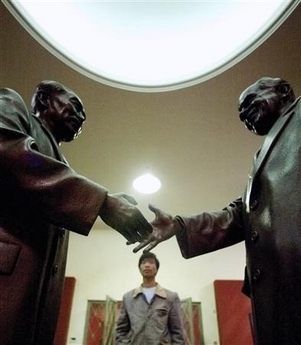
| A Chinese man looks at a sculpture of the handshake between the late former President Richard Nixon and the late Chinese Premier1 Zhou Enlai in Beijing on Nov. 20, 2002. |
| Nov. 7 - Almost 35 years after President Richard Nixon startled the world by visiting China, the boldness of the trip and his meeting with Mao Zedong still capture the imagination.
The week-long visit in February 1972 has often been portrayed2 as a remarkable3 success that allowed a vehemently4 anti-communist U.S. president to repair ties with China, put pressure on the Soviet5 Union and help ease Washington's path out of the Vietnam War. "This was the week that changed the world," Nixon declared at the end of the visit. The United States had refused to recognize China after the communist takeover in 1949, and bilateral6 ties had been icy for years. By the end of the 1960s, however, both nations needed each other. A diplomatically isolated7 and backward China, trying to recover from the disastrous8 reforms known as the Cultural Revolution, fretted9 about a possible attack by the neighboring Soviet Union. The United States, also worried about Moscow, wanted to boost its position in Asia and hoped China could help persuade ally North Vietnam to call a halt to hostilities10. So Nixon reversed two decades of official policy and went to Beijing. Although the hour-long talk between Nixon and Mao rarely went beyond generalities, the meeting was hugely significant. "It was an earthquake in the Cold War landscape and meant the Eastern Bloc11 no longer stood firm against the West," MacMillan writes in "Nixon in China." MacMillan, author of the best-selling book "Paris 1919," says Washington took a huge risk before Nixon's trip. As part of a bid to show good faith, national security adviser12 Henry Kissinger gave China reams of secret U.S. spy data on the Soviet Union. "They came rather as supplicants to the Chinese and they handed over huge amounts of intelligence and I think they left the Chinese with the impression that really the Americans needed them more than the Chinese needed the Americans," MacMillan told Reuters in an interview. In truth, the Chinese desperately13 needed help to escape what China's State Information Minister Cai Wu calls the chaos14 of the Cultural Revolution. "Nixon's visit opened a door at that time for China to the rest of the world," he said during a recent visit to Ottawa. Almost hidden among the fanfare15, banquets and media frenzy16 was the joint17 commitment to boost academic contacts as well as trade -- topics which did not interest Kissinger or Nixon. "The maximum amount of bilateral trade possible between us, even if we make great efforts, is infinitesimal in terms of our total economy," Kissinger told deputy Chinese Foreign Minister Qiao Guanhua. In reality, the academic visits quickly helped China build up vital knowledge and skills. And the promise of greater access to U.S. markets was crucial. After Mao died in 1976, his successors launched economic reforms that turned China into the powerhouse that is now, running a $200 billion trade surplus with the United States. China helps keep its rival afloat by buying vast amounts of U.S. debt. And despite Nixon's hopes, the China card did not result in effective pressure on North Vietnam to reach a peace deal. Even without Nixon's visit, she feels, China and the United States would eventually have come to an understanding. |
点击 收听单词发音
收听单词发音 |
1
premier
|
|
| adj.首要的;n.总理,首相 | |
参考例句: |
|
|
|
|
2
portrayed
|
|
| v.画像( portray的过去式和过去分词 );描述;描绘;描画 | |
参考例句: |
|
|
|
|
3
remarkable
|
|
| adj.显著的,异常的,非凡的,值得注意的 | |
参考例句: |
|
|
|
|
4
vehemently
|
|
| adv. 热烈地 | |
参考例句: |
|
|
|
|
5
Soviet
|
|
| adj.苏联的,苏维埃的;n.苏维埃 | |
参考例句: |
|
|
|
|
6
bilateral
|
|
| adj.双方的,两边的,两侧的 | |
参考例句: |
|
|
|
|
7
isolated
|
|
| adj.与世隔绝的 | |
参考例句: |
|
|
|
|
8
disastrous
|
|
| adj.灾难性的,造成灾害的;极坏的,很糟的 | |
参考例句: |
|
|
|
|
9
fretted
|
|
| 焦躁的,附有弦马的,腐蚀的 | |
参考例句: |
|
|
|
|
10
hostilities
|
|
| n.战争;敌意(hostility的复数);敌对状态;战事 | |
参考例句: |
|
|
|
|
11
bloc
|
|
| n.集团;联盟 | |
参考例句: |
|
|
|
|
12
adviser
|
|
| n.劝告者,顾问 | |
参考例句: |
|
|
|
|
13
desperately
|
|
| adv.极度渴望地,绝望地,孤注一掷地 | |
参考例句: |
|
|
|
|
14
chaos
|
|
| n.混乱,无秩序 | |
参考例句: |
|
|
|
|
15
fanfare
|
|
| n.喇叭;号角之声;v.热闹地宣布 | |
参考例句: |
|
|
|
|
16
frenzy
|
|
| n.疯狂,狂热,极度的激动 | |
参考例句: |
|
|
|
|
17
joint
|
|
| adj.联合的,共同的;n.关节,接合处;v.连接,贴合 | |
参考例句: |
|
|
|


©2005-2010英文阅读网