
CPC congress closes, opening new chapter for scientific development
时间:2007-10-22 08:13:19
(单词翻译:单击)

| The closing session of the 17th National Congress of the Communist Party of China (CPC) is held at the Great Hall of the People in Beijing, capital of China, Oct. 21, 2007. The 17th CPC National Congress closed here on Sunday. |
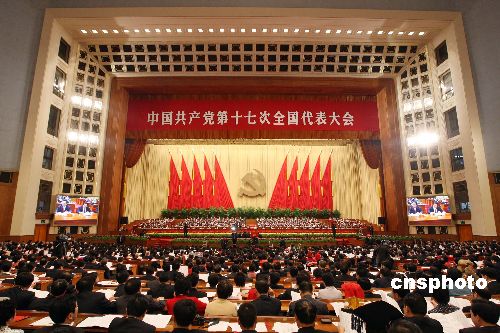
| BEIJING, Oct. 21-- The Communist Party of China CPC) closed its 17th National Congress on Sunday, endorsing1 the incorporation2 of the scientific outlook on development into the Party Constitution and installing a new 371-member Central Committee and a 127-member Central Commission for Discipline Inspection3.
At the closing session presided over by Hu Jintao, 2,235 delegates and specially4 invited guests selected 204 members and 167 alternate members of the 17th CPC Central Committee. Zeng Qinghong, Wu Guanzheng and Luo Gan, members of the Political Bureau Standing5 Committee of the 16th CPC Central Committee, were not on the central committee, while Hu Jintao, Wu Bangguo, Wen Jiabao, Jia Qinglin and Li Changchun have secured seats. As is customary, the new central committee will hold its first plenary session the following day of the conclusion of the Party congress. According to the CPC Constitution, the plenum elects the central committee's general secretary, members and alternate members of its political bureau, and members of the political bureau standing committee. The general secretary shall be chosen from political bureau standing committee members. It was the fifth time that competitive election was used at the CPC congress. At least eight percent of nominees6 have been eliminated in the primary elections for the central committee and central discipline commission, larger than that at the 16th CPC National Congress in 2002, indicating a sign of progress of intra-Party democracy. AMENDED7 CONSTITUTION The closing meeting also passed a resolution on the amendments8 to the Party Constitution, which enshrined the scientific outlook on development and unveiled the Party's determination to promote more coordinated9 development on the basis of social harmony, environmental protection and energy conservation in addition to economic expansion. The CPC, which was established in 1921 and took power 28 years later, has routinely amended its Constitution on past national congresses to keep up with the times. At this congress, the CPC has blended its policies and principles on the work related to religious affairs into its charter for the first time and declared it would "unswervingly encourage, support and guide the development of the non-public sector10" in light of new circumstances and tasks. The amendments also involved the establishment of a sound system that could stage a comprehensive combat against corrupted11 officials and address both the symptoms and root causes of corruption12. A tenure13 system for delegates to Party congresses at all levels is to be adopted while the transparency of Party affairs must be increased at all levels. The resolution said the amendments, unanimously approved at the congress, would "further strengthen Party building, constantly enhance the Party's governance capability14 and maintain and develop its vanguard nature". The meeting hailed the scientific outlook on development as "a continuation and development" of the important thoughts on development advanced by the three generations of the Party's central collective leadership and a concentrated expression of the Marxist world outlook and methodology with regard to development. In a speech at the closing ceremony, Hu Jintao urged the delegates to bear in mind their "sacred responsibility", seriously study the Constitution and implement15 the theories and guidelines it upholds. The meeting also passed resolutions on the reports of the 16th CPC Central Committee and Central Commission for Discipline Inspection and fully16 approved the work the Party has done in past five years. "The successful practices since the reform and opening up policy was introduced 29 years ago have incontrovertibly proved that the decision to begin reform and opening up is vital to the destiny of contemporary China," said the resolution.
|
点击 收听单词发音
收听单词发音 |
1
endorsing
|
|
| v.赞同( endorse的现在分词 );在(尤指支票的)背面签字;在(文件的)背面写评论;在广告上说本人使用并赞同某产品 | |
参考例句: |
|
|
|
|
2
incorporation
|
|
| n.设立,合并,法人组织 | |
参考例句: |
|
|
|
|
3
inspection
|
|
| n.检查,审查,检阅 | |
参考例句: |
|
|
|
|
4
specially
|
|
| adv.特定地;特殊地;明确地 | |
参考例句: |
|
|
|
|
5
standing
|
|
| n.持续,地位;adj.永久的,不动的,直立的,不流动的 | |
参考例句: |
|
|
|
|
6
nominees
|
|
| n.被提名者,被任命者( nominee的名词复数 ) | |
参考例句: |
|
|
|
|
7
Amended
|
|
| adj. 修正的 动词amend的过去式和过去分词 | |
参考例句: |
|
|
|
|
8
amendments
|
|
| (法律、文件的)改动( amendment的名词复数 ); 修正案; 修改; (美国宪法的)修正案 | |
参考例句: |
|
|
|
|
9
coordinated
|
|
| adj.协调的 | |
参考例句: |
|
|
|
|
10
sector
|
|
| n.部门,部分;防御地段,防区;扇形 | |
参考例句: |
|
|
|
|
11
corrupted
|
|
| (使)败坏( corrupt的过去式和过去分词 ); (使)腐化; 引起(计算机文件等的)错误; 破坏 | |
参考例句: |
|
|
|
|
12
corruption
|
|
| n.腐败,堕落,贪污 | |
参考例句: |
|
|
|
|
13
tenure
|
|
| n.终身职位;任期;(土地)保有权,保有期 | |
参考例句: |
|
|
|
|
14
capability
|
|
| n.能力;才能;(pl)可发展的能力或特性等 | |
参考例句: |
|
|
|
|
15
implement
|
|
| n.(pl.)工具,器具;vt.实行,实施,执行 | |
参考例句: |
|
|
|
|
16
fully
|
|
| adv.完全地,全部地,彻底地;充分地 | |
参考例句: |
|
|
|


©2005-2010英文阅读网