
Chinese leaders agree in principle to visit Japan next year
时间:2006-12-20 01:11:22
(单词翻译:单击)
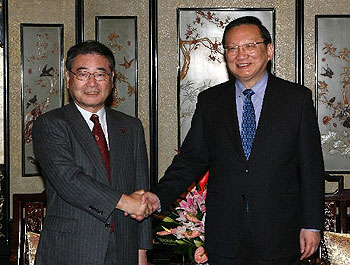
| Chinese State Councilor Tang Jiaxuan (R) meets with Koichi Kato,former Secretary-General of the Liberal Democratic Party (LDP) and a member of the House of Representatives, in Beijing, Dec. 18, 2006. (Xinhua Photo) |
| BEIJING, Dec. 19 - Chinese leaders agree in principle to visit Japan next year, said State Councilor Tang Jiaxuan here Monday.
Tang made the remarks when meeting with Koichi Kato, former Secretary-General of the Liberal Democratic Party (LDP) and a member of the House of Representatives. Tang said the two sides should regard the visit as an opportunity to promote friendly exchanges and cooperation in various fields and map out a long-term development plan for bilateral1 relations. The two countries should also further consolidate2 the "three foundations" for the sound, long-term, stable development of bilateral relations, namely the political foundation, economic foundation and people-to-people relations, he added. New Japanese Prime Minister Shinzo Abe paid an official visit to China in October after assuming the premiership, the first visit to China by a Japanese prime minister in the past five years. During his visit, the two sides issued a joint3 press communique, in which the Japanese side invited Chinese leaders to visit Japan, and the Chinese side expressed gratitude4 and consent in principle for the invitation. Tang said relations between China and Japan are improving. The elimination5 of political obstacles and the resumption of high-level visits will inject vigor6 into bilateral relations and benefit the two countries and two peoples. Koichi agreed that China-Japan relations had improved since Abe's China visit. The trend is in the interests of both countries and is welcomed by all circles in Japan and other Asian nations. The 21st century is the Asian century. Only if China and Japan have a better relationship can they build a bright future for Asia, Koichi said, adding he will continue his efforts in favor of a sound and stable development of China-Japan relations. Tang also stressed the need to handling major sensitive issues properly, including the history issue and the Taiwan issue, so as to ward7 off hindrances8 to the improvement and development of bilateral relations. He said the two sides should expand their common interests and establish strategic relations to revitalize Asia, and contribute to Asian peace, development and harmony. The Japanese guests are visiting China at the invitation of the Chinese People's Institute of Foreign Affairs.
|
点击 收听单词发音
收听单词发音 |
1
bilateral
|
|
| adj.双方的,两边的,两侧的 | |
参考例句: |
|
|
|
|
2
consolidate
|
|
| v.使加固,使加强;(把...)联为一体,合并 | |
参考例句: |
|
|
|
|
3
joint
|
|
| adj.联合的,共同的;n.关节,接合处;v.连接,贴合 | |
参考例句: |
|
|
|
|
4
gratitude
|
|
| adj.感激,感谢 | |
参考例句: |
|
|
|
|
5
elimination
|
|
| n.排除,消除,消灭 | |
参考例句: |
|
|
|
|
6
vigor
|
|
| n.活力,精力,元气 | |
参考例句: |
|
|
|
|
7
ward
|
|
| n.守卫,监护,病房,行政区,由监护人或法院保护的人(尤指儿童);vt.守护,躲开 | |
参考例句: |
|
|
|
|
8
hindrances
|
|
| 阻碍者( hindrance的名词复数 ); 障碍物; 受到妨碍的状态 | |
参考例句: |
|
|
|
- 上一篇:Six-party talks resume amid cautious expectations
- 下一篇:Public order: China's most serious problem


©2005-2010英文阅读网