
Wen: China to follow opening up policy
时间:2007-11-20 07:53:59
(单词翻译:单击)
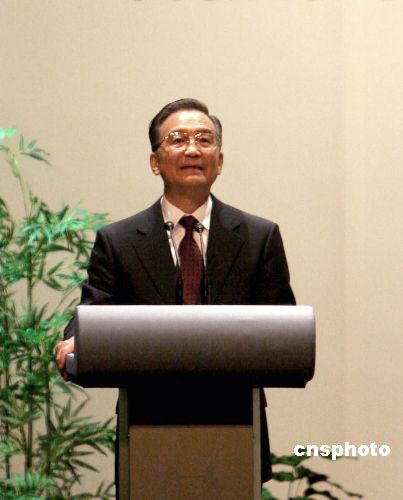
| Chinese Premier1 Wen Jiabao delivers a speech at the National University of Singapore. |
| Nov. 20 - Visiting Chinese Premier Wen Jiabao expounded2 on China's opening up policy on Monday, saying China will unswervingly follow the set policy.
Delivering a speech entitled "Only an Open and Inclusive Nation Can Be Strong" at the National University of Singapore, Wen said the 17th National Congress of the Communist Party of China convened3 in October highlighted China's resolve to pursue reform and opening up and to build socialism with distinctive4 Chinese characteristics and its confidence in accomplishing this endeavor. China's opening up policy is long-term, comprehensive in nature and based on mutual5 benefit, said the Chinese premier. "China's opening up policy is a long-term one," Wen said, noting that the policy has brought great benefits to more than 1 billion Chinese. China will not change the policy since a right policy benefits the country and enjoys the support of the people, Wen said. "To deviate6 from this policy will only impede7 China's development and we will lose popular support," he said, "This is the fundamental reason why China will stay on the track of opening up." "Opening up is crucial to China's reform and modernization8 endeavor. It is a basic state policy, not expediency," he said, "Though the specific measures and means to implement9 this policy may differ in different stages, the basic policy will not change." "China's opening up is comprehensive in nature," Wen said, "We are open not only to the developed countries, but also to the developing countries. We are open not only in economy, but also in fields such as science, technology, education and culture." The Chinese premier said only by opening up can the country bring in advanced and useful practices. "We should boldly absorb and draw upon all the achievements of the human society, including those of the capitalist countries, build on them and make innovations," Wen said. "China's opening up policy is based on mutual benefit," he said in the speech. Singapore's Minister Mentor10 Lee Kuan Yew11 was present. "We are developing a socialist12 market economy under the conditions of economic globalization, and this naturally means we should open ourselves to the world, build inter-dependent economic ties with other countries, gain close access to the international market and integrate ourselves into the world economy," he said. The premier said China is committed to carrying out mutually beneficial cooperation on an equal basis with other countries in accordance with the law of the market. Opening up not only benefits China's development, but also contributes to world development, he said. Only on the basis of mutual benefit and win-win progress can opening up endure and be conducive13 to the fundamental interests of all peoples and peace and prosperity of the world, he added. The premier said that the world today is an open one and no country can achieve development in isolation14. "We are working to build socialism with distinctive Chinese characteristics, and our fundamental objective is to boost productive forces and meet the increasing material and cultural needs of the people," Wen said. "To meet this goal, we must remain committed to opening up while addressing issues arising in the course of domestic development and reform." Wen said China will participate in economic globalization at a higher level and focus on addressing new issues in opening up. "We favor free trade and oppose protectionism," he said, "We will speed up changing the mode of trade growth, improve trade mix and strive to reduce trade imbalances. The Chinese premier said China is committed to the basic policy of introducing foreign capital and will develop innovative15 ways, optimize16 the structure and raise the efficiency of introducing foreign capital. "We will continue to follow an independent, gradual and controllable approach in improving the Chinese yuan exchange rate mechanism17, increasing its flexibility18 and gradually make the Chinese yuan convertible19 under the capital account," he said. On the climate change, Wen said China is ready to join world efforts in tackling climate change within the framework of the U.N. Framework Convention on Climate Change and the Kyoto Protocol20 and in accordance with the principle of "common but differentiated21 responsibilities." "We have put in place the legal framework governing opening up and will continue to improve it to place foreign investment activities in China under the rule of law and protect the lawful22 rights and interests of foreign investors," said the premier. Wen highlighted the role of opening up and inclusiveness in development of a country, saying they have both created Singapore's success and contributed to China's development. "Mutual opening up and inclusiveness between China and Singapore have led to rapid growth in our cooperation," Wen said. Trade between China and Singapore totaled 40.85 billion U.S. dollars last year, 15 times the figure of 1990 when the two countries established diplomatic ties. Last year also saw 1.8 million mutual visits between China and Singapore, an 18-fold increase over 1990. Citing the Suzhou Industrial Park as a success story in China-Singapore cooperation, Wen said the two countries' joint23 efforts in building ecologically friendly cities will be a good initiative for China and Singapore to promote sustainable development in keeping with the trends of the times. To draw upon Singapore's experience on its public order and management, China has sent over 9,000 officials for training in Singapore in the past decade. "By drawing on their respective strengths and maintaining close cooperation, China and Singapore have both become winners," he said. Responding to a proposal by Minister Mentor Lee Kuan Yew, the Singapore Chinese Chamber24 of Commerce and Industry has recently set up an organization known as "Business China," which offers a new platform for conducting cultural and business exchanges between the two countries. "We hope 'Business China' will create more opportunities for the growth of China-Singapore relations," the Chinese premier said. "Reviewing the past and looking ahead to the future, we have every confidence in the future of China-Singapore relations," he said. China and Singapore can expect new opportunities for cooperation in development as China, guided by the scientific outlook on development, strives to build a moderately prosperous society and Singapore is pursuing the strategy to remake the country. "We will continue to increase exchanges and cooperation with Singapore," he said, "Our cooperation will have an even brighter future," he added. Wen arrived in Singapore on Sunday for an official visit to Singapore. During his stay in Singapore, he will also attend the 11th ASEAN plus Three summit, the 11th China-ASEAN summit, the third East Asia summit and the eighth meeting of leaders of China, Japan and South Korea.
|
点击 收听单词发音
收听单词发音 |
1
premier
|
|
| adj.首要的;n.总理,首相 | |
参考例句: |
|
|
|
|
2
expounded
|
|
| 论述,详细讲解( expound的过去式和过去分词 ) | |
参考例句: |
|
|
|
|
3
convened
|
|
| 召开( convene的过去式 ); 召集; (为正式会议而)聚集; 集合 | |
参考例句: |
|
|
|
|
4
distinctive
|
|
| adj.特别的,有特色的,与众不同的 | |
参考例句: |
|
|
|
|
5
mutual
|
|
| adj.相互的,彼此的;共同的,共有的 | |
参考例句: |
|
|
|
|
6
deviate
|
|
| v.(from)背离,偏离 | |
参考例句: |
|
|
|
|
7
impede
|
|
| v.妨碍,阻碍,阻止 | |
参考例句: |
|
|
|
|
8
modernization
|
|
| n.现代化,现代化的事物 | |
参考例句: |
|
|
|
|
9
implement
|
|
| n.(pl.)工具,器具;vt.实行,实施,执行 | |
参考例句: |
|
|
|
|
10
mentor
|
|
| n.指导者,良师益友;v.指导 | |
参考例句: |
|
|
|
|
11
yew
|
|
| n.紫杉属树木 | |
参考例句: |
|
|
|
|
12
socialist
|
|
| n.社会主义者;adj.社会主义的 | |
参考例句: |
|
|
|
|
13
conducive
|
|
| adj.有益的,有助的 | |
参考例句: |
|
|
|
|
14
isolation
|
|
| n.隔离,孤立,分解,分离 | |
参考例句: |
|
|
|
|
15
innovative
|
|
| adj.革新的,新颖的,富有革新精神的 | |
参考例句: |
|
|
|
|
16
optimize
|
|
| v.使优化 [=optimise] | |
参考例句: |
|
|
|
|
17
mechanism
|
|
| n.机械装置;机构,结构 | |
参考例句: |
|
|
|
|
18
flexibility
|
|
| n.柔韧性,弹性,(光的)折射性,灵活性 | |
参考例句: |
|
|
|
|
19
convertible
|
|
| adj.可改变的,可交换,同意义的;n.有活动摺篷的汽车 | |
参考例句: |
|
|
|
|
20
protocol
|
|
| n.议定书,草约,会谈记录,外交礼节 | |
参考例句: |
|
|
|
|
21
differentiated
|
|
| 区分,区别,辨别( differentiate的过去式和过去分词 ); 区别对待; 表明…间的差别,构成…间差别的特征 | |
参考例句: |
|
|
|
|
22
lawful
|
|
| adj.法律许可的,守法的,合法的 | |
参考例句: |
|
|
|
|
23
joint
|
|
| adj.联合的,共同的;n.关节,接合处;v.连接,贴合 | |
参考例句: |
|
|
|
|
24
chamber
|
|
| n.房间,寝室;会议厅;议院;会所 | |
参考例句: |
|
|
|


©2005-2010英文阅读网