
China to unify corporate income tax rates
时间:2006-12-25 02:49:35
(单词翻译:单击)
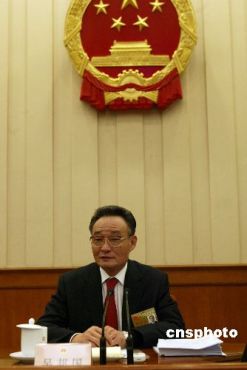
| China's top legislator, Wu Bangguo presides at the 25th session of the 10th Standing1 Committee of the National People's Congress (NPC) in Beijing, Dec. 24, 2006. |
| Dec. 24 - China's top legislature began discussing Sunday a new law on corporate2 income tax that will unify3 income tax rates for domestic and foreign companies at 25 percent.
The draft law was tabled at the 25th session of the 10th Standing Committee of the National People's Congress (NPC), which convenes4 from Dec. 24 to 29. A unified5 tax code will create a taxation6 environment that favors fair competition among all ventures registered in China, said Finance Minister Jin Renqing at the meeting. Two different corporate income tax regimes were established for domestic companies in 1991 and overseas companies in 1993 with overseas companies enjoying a lower tax burden. In recent years, this system has been hotly debated. Chinese companies currently pay income tax at a nominal7 rate of 33 percent, while their foreign counterparts -- who benefit from tax waivers and incentives8 to encourage investment in China -- payan average of 15 percent. In fact, when all kinds of tax breaks and incentives are taken into account at both national and local level, domestic companies pay around 24 percent and overseas-funded businesses 14 percent. Many people believe that the gap handicaps domestic players who have been facing tougher competition since China joined the World Trade Organization in 2001. "As the current tax system is overly complicated, we need to unify corporate income tax rates," said Jin. The minister said some companies take advantage of loopholes in the system to evade9 tax. Legislators said the 25-percent tax rate compares favorably with other countries and regions and with international rates. According to the draft law, income tax for small businesses with low profits will be limited to 20 percent. Depending on what region and what industry they are active in, small businesses now pay either 18 percent or 27 percent. To put domestic businesses on an equal footing with their foreign counterparts, the bill authorizes10 domestic companies to deduct11 employees' full salaries from taxable income as foreign companies do. Up until now, domestic companies could only deduct a maximum of 1,600 yuan (200 U.S. dollars) per person. The two-year full tax exemption12 and three-year partial tax exemption for foreign manufacturers will be rescinded13 and export-oriented foreign-funded businesses will no longer enjoy a special fifty percent tax break. |
点击 收听单词发音
收听单词发音 |
1
standing
|
|
| n.持续,地位;adj.永久的,不动的,直立的,不流动的 | |
参考例句: |
|
|
|
|
2
corporate
|
|
| adj.共同的,全体的;公司的,企业的 | |
参考例句: |
|
|
|
|
3
unify
|
|
| vt.使联合,统一;使相同,使一致 | |
参考例句: |
|
|
|
|
4
convenes
|
|
| 召开( convene的第三人称单数 ); 召集; (为正式会议而)聚集; 集合 | |
参考例句: |
|
|
|
|
5
unified
|
|
| (unify 的过去式和过去分词); 统一的; 统一标准的; 一元化的 | |
参考例句: |
|
|
|
|
6
taxation
|
|
| n.征税,税收,税金 | |
参考例句: |
|
|
|
|
7
nominal
|
|
| adj.名义上的;(金额、租金)微不足道的 | |
参考例句: |
|
|
|
|
8
incentives
|
|
| 激励某人做某事的事物( incentive的名词复数 ); 刺激; 诱因; 动机 | |
参考例句: |
|
|
|
|
9
evade
|
|
| vt.逃避,回避;避开,躲避 | |
参考例句: |
|
|
|
|
10
authorizes
|
|
| 授权,批准,委托( authorize的名词复数 ) | |
参考例句: |
|
|
|
|
11
deduct
|
|
| vt.扣除,减去 | |
参考例句: |
|
|
|
|
12
exemption
|
|
| n.豁免,免税额,免除 | |
参考例句: |
|
|
|
|
13
rescinded
|
|
| v.废除,取消( rescind的过去式和过去分词 ) | |
参考例句: |
|
|
|
- 上一篇:Algae product making companies united against foreign acquis
- 下一篇:Over 30 self-innovative sedan types go on market this year


©2005-2010英文阅读网