
Hong Kong passes NYC in attracting IPOs
时间:2006-12-25 02:52:40
(单词翻译:单击)
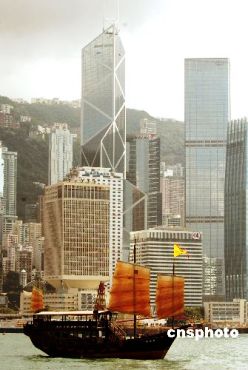
| Hong Kong's amazing success was due to several factors, analysts1 say. Being next door to mainland China's booming economy was a huge help. |
| Dec. 25 - Hong Kong surged past New York this year and became the world's second most popular place — after London — for companies to float new stock listings.
The city's amazing success was due to several factors, analysts say. Being next door to mainland China's booming economy was a huge help. Tough new U.S. accounting2 rules have discouraged many companies from listing in America. Perhaps most importantly, Hong Kong benefited from a new trend that involves the rise of regional markets, diminishing the importance of places like New York. With the help of powerful computers and increasing liquidity3, capital can easily zoom4 around the world, scouting5 for the best investments. But Hong Kong is keenly aware the competition for global investors6 is fierce. Already, there's much discussion about how long the good times can last. Some are worrying about other upstart markets — especially the Shanghai Stock Exchange — which might soon be able to elbow their way into the big leagues. Hong Kong's big advantage now is that it has a solid legal and financial system that can handle big initial public offerings, or IPOs. Shanghai isn't close to being able to match this city, and that's why a parade of China's biggest banks decided7 to launch record-breaking IPOs in Hong Kong this year. One of them was the world's biggest ever: the $21.9 billion offering in October by Industrial & Commercial Bank of China, the mainland's largest lender. With two weeks left in the year, Hong Kong has raked in HK$307.7 billion, or US$39.57 billion, in IPOs — nearly twice as much as the HK$165.7 billion raised last year, according to Hong Kong Exchanges & Clearing Ltd., the listed firm that operates the stock exchange. London was the world leader for IPO equity8 raised, with $48.92 billion raised, according to the World Federation9 of Exchanges. Hong Kong was second and the New York Stock Exchange lagged back in third with $33.61 billion, according to the most recent WFE figures, which included the January-November period. That may be partly because some American companies are holding back from listing in the U.S. due to the strict rules under the Sarbanes-Oxley anti-fraud law, opting10 instead to stay private. But few of them have turned to Hong Kong. The growth in IPO issuance here has been driven almost entirely11 by Chinese companies eager to tap international capital markets. Beating out New York for the No. 2 spot has inspired much chest-thumping by Hong Kong leaders. Frederick Ma, secretary for financial services and the treasury12, has argued that the IPO success confirms Hong Kong's status as an international financial center. And he contends that it will continue to grow because of its strong link to China. "If China becomes a large economy rivaling the U.S., then Hong Kong will grow to the extent of New York and London," he said in a speech to the Foreign Correspondents' Club. Ma said Hong Kong was already benefiting from a new clustering of businesses drawn13 to the city because of its success in finance. The world's top 70 banks are operating there, he said. In 1995, the city only had 200 chartered financial analysts, but now it has 3,000 — ranking it No. 4 in the world behind the U.S., Canada and Britain, he said. But some say the back patting is premature14 and that Hong Kong is nothing more than a regional finance center. Jake van der Kamp, a finance columnist15 for Hong Kong's South China Morning Post and a former investment banker, said a true global finance capital should be like a long dining table with several legs. He noted16 that Hong Kong doesn't offer much in the way of bond, foreign exchange and commodities trading. When the giant Industrial & Commercial Bank of China launched its IPO in October, it decided to do a historic dual17 listing in Hong Kong and Shanghai. Shanghai is still a minnow compared to Hong Kong, which has average daily turnover18 of $4.21 billion — 12 times the volume of Shanghai. But this will likely change. "China's domestic markets are growing up, developing their own importance, and it will be a challenge going forward to other markets in the world," said Hans Schuettler, managing director and chief executive officer in Asia for Morgan Stanley & Co. But Schuettler said that a regional market would grow up in Asia. "This is what we've seen in Europe. This is what I definitely expect to happen in a more pronounced version here," he said. One thing Hong Kong needs to be more aggressive about doing is attracting IPOs by companies that have operations in China but are owned by firms in the U.S., Canada, Germany and other places, said Ronald Arculli, chairman of Hong Kong Exchanges & Clearing. Arculli was also confident that economic growth in Asia — particularly in India and China — will send plenty of business Hong Kong's way. He agreed that, like Europe, the region will have room for more than one big stock market. "What's the problem with Asia having Hong Kong, Shanghai, Tokyo and India?" he said. "We are two-thirds of the world's population, with two of the biggest economic powerhouses in the next 20 to 30 years to come. There's plenty for everyone."
|
点击 收听单词发音
收听单词发音 |
1
analysts
|
|
| 分析家,化验员( analyst的名词复数 ) | |
参考例句: |
|
|
|
|
2
accounting
|
|
| n.会计,会计学,借贷对照表 | |
参考例句: |
|
|
|
|
3
liquidity
|
|
| n.流动性,偿债能力,流动资产 | |
参考例句: |
|
|
|
|
4
zoom
|
|
| n.急速上升;v.突然扩大,急速上升 | |
参考例句: |
|
|
|
|
5
scouting
|
|
| 守候活动,童子军的活动 | |
参考例句: |
|
|
|
|
6
investors
|
|
| n.投资者,出资者( investor的名词复数 ) | |
参考例句: |
|
|
|
|
7
decided
|
|
| adj.决定了的,坚决的;明显的,明确的 | |
参考例句: |
|
|
|
|
8
equity
|
|
| n.公正,公平,(无固定利息的)股票 | |
参考例句: |
|
|
|
|
9
federation
|
|
| n.同盟,联邦,联合,联盟,联合会 | |
参考例句: |
|
|
|
|
10
opting
|
|
| v.选择,挑选( opt的现在分词 ) | |
参考例句: |
|
|
|
|
11
entirely
|
|
| ad.全部地,完整地;完全地,彻底地 | |
参考例句: |
|
|
|
|
12
treasury
|
|
| n.宝库;国库,金库;文库 | |
参考例句: |
|
|
|
|
13
drawn
|
|
| v.拖,拉,拔出;adj.憔悴的,紧张的 | |
参考例句: |
|
|
|
|
14
premature
|
|
| adj.比预期时间早的;不成熟的,仓促的 | |
参考例句: |
|
|
|
|
15
columnist
|
|
| n.专栏作家 | |
参考例句: |
|
|
|
|
16
noted
|
|
| adj.著名的,知名的 | |
参考例句: |
|
|
|
|
17
dual
|
|
| adj.双的;二重的,二元的 | |
参考例句: |
|
|
|
|
18
turnover
|
|
| n.人员流动率,人事变动率;营业额,成交量 | |
参考例句: |
|
|
|
- 上一篇:China to join int'l treaties to combat Internet piracy
- 下一篇:HSBC set up its 29th subbranch in China


©2005-2010英文阅读网