
Chew for Health
(单词翻译:单击)
This exciting research is just beginning. And in the meantime, companies are also experimenting with adding vitamins, minerals, medicines, and other substances that could give gum the power to cure headaches and fight everything from serious diseases to bad breath.
These enhanced gums are part of the growing number of foods and drinks that contain health-boosting ingredients. If you're already a gum fan, that's probably welcome news.
Making gum
People have been chewing gum for thousands of years. Ancient Greeks, Mayas, and Native Americans, for example, chewed on the sap, or resin1, of certain types of trees.
 |
|
Could gum be good for you? Scientists think so. |
|
|
Today, gum is a little more complicated, says Ron Ream, a food scientist in Plano, Ill. Gum manufacturers start by mixing resin, wax, and a molecule2 called polyvinyl acetate to make a gum base. By varying the types and amounts of these ingredients, scientists can make thousands of formulations.
Giant mixers then combine vats3 of melted gum base with powders, syrups4, and sweeteners. Other machines roll the goo into sticks or press them into pellets. Packaging is the final step.
Americans chew about 1.8 pounds of gum per person each year, according to the U.S. Census5 Bureau. By showing that gum chewing can be healthy, companies that make and sell gum hope that we'll chew even more.
Just what can gum do for your health? Many studies show that chewing gum after meals fights cavities by stimulating6 the production of saliva7. Saliva helps wash away bacteria that damage our teeth.
An ingredient called xylitol, which is added to some gums, provides an extra dose of cavity-fighting power. This is good for more than just the teeth. Research suggests that good oral health decreases the risk of heart disease, diabetes8, and other serious diseases.
|
Gum made with sugar can promote cavities. But some gums contain an ingredient that fights tooth decay. Chewing also stimulates production of saliva, which washes away cavity-causing bacteria. |
|
|
Nutritionist Gil Leveille, executive director of the Wrigley Science Institute, says that chewing gum might also be good for your brain. One Japanese study of nine participants, he says, found that chewing gum boosted the flow of blood to participants' brains by up to 40 percent. Blood carries oxygen, which fuels brain cells.
Other small studies have found that people perform better on memory tests while chewing gum. And a study in the United Kingdom found that people who chewed gum while memorizing a list of words did about 25 percent better at recalling those words than people who didn't chew gum.
"It certainly makes sense," Leveille says, "that increased blood flow would be related to increased alertness."
Additional studies, with longer follow-up, are needed to confirm that chewing gum has benefits, he adds. So far, results of studies about memory have been mixed. Not all tests have had similarly encouraging results. What's more, many of the studies that show gum's benefits are funded by gum companies.
Medicine gumballs
Other researchers are finding that gum might work better than a pill to deliver medicines and other substances into the bloodstream. That's because the lining10 of our cheeks can absorb certain substances more quickly than our stomachs and intestines11 can.
 |
|
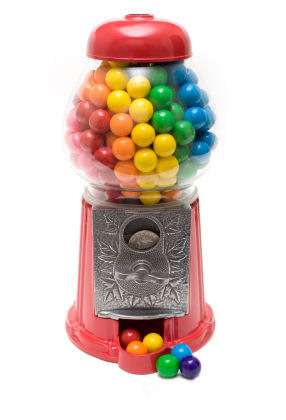
Chewing a gumball or stick of gum that contains a medicine might help a person more than taking a tablet or a pill that contains the same medicine. |
|
|
In 2006, Danish scientists found that people absorbed nearly three times as much of an allergy12 medicine when they chewed it in gum as when they swallowed it in tablet form. The researchers found that 40 percent of the medicine entered the bloodstream directly through the cheeks of the gum-chewing patients.
That discovery could help other researchers develop medicine-containing gums that fight colds, relieve headaches, battle nervousness, and more. Scientists might even create antimicrobial gums that cure bad breath.
Those projects may take years, but gum scientists have already had at least one recent success: They've created a gum that could help us stay awake.
Researchers at the Walter Reed Army Institute of Research (WRAIR) in Silver Spring, Md., manufactured a caffeine-laced gum called Stay Alert. Each stick has as much caffeine as a cup of coffee.
It can take an hour for the caffeine in coffee to have its full effect, but the caffeine in Stay Alert hits in just a few minutes, says WRAIR research physiologist13 Gary Kamimori.
 |
|
|
|
|
Chewing Stay Alert is "like pouring coffee directly into your bloodstream," he says.
The military helped invent the product because it wants to be sure that soldiers stay awake during long, tiring night shifts. Kamimori's studies show that soldiers who chew Stay Alert can function well for up to 72 hours without sleep.
The gum is easy to transport and it's stable in cold and hot climates, Kamimori says. Unlike a pill, it doesn't require water to swallow. Those qualities make it easy for soldiers to use.
For now, Stay Alert is available only to the military, Kamimori says. The manufacturer may one day offer it for sale to the public. People who work at night, such as truck drivers and medical personnel who ride in ambulances, might benefit from a product such as Stay Alert.
Some caffeine gums are already available in stores, but they haven't been as rigorously tested or regulated as Stay Alert has, says Kamimori. Testing is essential because untested products might be harmful to health, or they simply might not do what they claim to do.
Let the chewer beware
For now, chew with caution. Too much chewing can damage the jaw14 joint15. And chewing too much of a gum that contains vitamins, caffeine, or a medicine could lead to an overdose, warns Gayl Canfield, a registered dietitian16 at the Pritikin Longevity17 Center & Spa in Aventura, Fla. What's more, no matter how healthy gum chewing proves to be, she adds, it will never be a match for a healthy lifestyle.
"Nothing like a gum or a vitamin is going to cure a bad dietary habit or a bad exercise habit," Canfield says. "It's not a magic bullet."
 收听单词发音
 |
1
resin
|
|
| n.树脂,松香,树脂制品;vt.涂树脂 | |
参考例句: |
|
|
|
|
2
molecule
|
|
| n.分子,克分子 | |
参考例句: |
|
|
|
|
3
vats
|
|
| varieties 变化,多样性,种类 | |
参考例句: |
|
|
|
|
4
syrups
|
|
| n.糖浆,糖汁( syrup的名词复数 );糖浆类药品 | |
参考例句: |
|
|
|
|
5
census
|
|
| n.(官方的)人口调查,人口普查 | |
参考例句: |
|
|
|
|
6
stimulating
|
|
| adj.有启发性的,能激发人思考的 | |
参考例句: |
|
|
|
|
7
saliva
|
|
| n.唾液,口水 | |
参考例句: |
|
|
|
|
8
diabetes
|
|
| n.糖尿病 | |
参考例句: |
|
|
|
|
9
stimulates
|
|
| v.刺激( stimulate的第三人称单数 );激励;使兴奋;起兴奋作用,起刺激作用,起促进作用 | |
参考例句: |
|
|
|
|
10
lining
|
|
| n.衬里,衬料 | |
参考例句: |
|
|
|
|
11
intestines
|
|
| n.肠( intestine的名词复数 ) | |
参考例句: |
|
|
|
|
12
allergy
|
|
| n.(因食物、药物等而引起的)过敏症 | |
参考例句: |
|
|
|
|
13
physiologist
|
|
| n.生理学家 | |
参考例句: |
|
|
|
|
14
jaw
|
|
| n.颚,颌,说教,流言蜚语;v.喋喋不休,教训 | |
参考例句: |
|
|
|
|
15
joint
|
|
| adj.联合的,共同的;n.关节,接合处;v.连接,贴合 | |
参考例句: |
|
|
|
|
16
dietitian
|
|
| n.营养学家 | |
参考例句: |
|
|
|
|
17
longevity
|
|
| n.长命;长寿 | |
参考例句: |
|
|
|


