
China Story at the Olympic Village 4
(单词翻译:单击)
Lianpu is a unique way to portrait characters, which is native to China. It refers to the color patterns painted on the faces of opera performers. Specific types of facial make-up are exploited in Peking Opera to symbolize1 the personalities2, characteristics, and fates of the roles. Usually, red faces have positive meanings, symbolizing3 brave, faithful, and wise men. Another positive color is purple, which signifies wisdom and bravery.
In addition to Zhao Yongqi, Zhang Xing, the painter of ladle masks from Baoji, Shaanxi Province, is also drawing attention with his painting skill. From ancient times, the ladle masks, usually made of willow4 woods, were used to exorcise evils and pray for auspice and safety. Along with other traditional Chinese arts like shadow plays, embroidery5, clay sculpture and kite-making, the ladle masking became windows to showcase the folk arts that have become rarities.
Kites
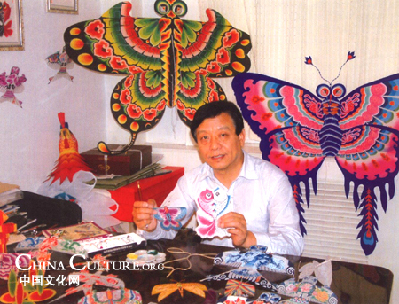 |
Kites were invented by the Chinese people over 2000 years ago. The art of Chinese kites has developed endlessly alongside the long history of the nation's cultural traditions. Various art systems and genres6 have formed over time. Generally, there are six kinds: Beijing kite, Weifang kite, Tianjin kite, Nantong kite, Jiangnan kite, and Taiwan kite.
The characteristics of Beijing kites include delicate frameworks, precise colored drawings, naturalness and gracefulness7, and a high worthiness8 of being viewed and admired. Typical Beijing kites are Cao, Jin, and Ha kites, with new types of Beijing kites having come forth9 in a great number in recent years.
Ha Yiqi, the fourth-generation successor of Beijing Ha Kite, and Kong Bingzhang, the third-generation successor Cao Kite, are at the Olympic Village to produce Beijing-styled kites on the spot.
More folk artists are here to demonstrate their skills such as Zhang Junxian and Zhang Baolin who are good at making dough10 sculptures with vivid facial expressions; Jin Jiahong uses needles and threads to work out Hangzhou embroidery featuring with artistic11 fascination12; Gu Haohua’s tiger-head shoes are one of the best gifts for children to drive away evil spirits and Chen Haili’s Farmer Painting impresses people with audacious visuals.
Editor: Dong Jirong
 收听单词发音
 |
1
symbolize
|
|
| vt.作为...的象征,用符号代表 | |
参考例句: |
|
|
|
|
2
personalities
|
|
| n. 诽谤,(对某人容貌、性格等所进行的)人身攻击; 人身攻击;人格, 个性, 名人( personality的名词复数 ) | |
参考例句: |
|
|
|
|
3
symbolizing
|
|
| v.象征,作为…的象征( symbolize的现在分词 ) | |
参考例句: |
|
|
|
|
4
willow
|
|
| n.柳树 | |
参考例句: |
|
|
|
|
5
embroidery
|
|
| n.绣花,刺绣;绣制品 | |
参考例句: |
|
|
|
|
6
genres
|
|
| (文学、艺术等的)类型,体裁,风格( genre的名词复数 ) | |
参考例句: |
|
|
|
|
7
gracefulness
|
|
参考例句: |
|
|
|
|
8
worthiness
|
|
| 价值,值得 | |
参考例句: |
|
|
|
|
9
forth
|
|
| adv.向前;向外,往外 | |
参考例句: |
|
|
|
|
10
dough
|
|
| n.生面团;钱,现款 | |
参考例句: |
|
|
|
|
11
artistic
|
|
| adj.艺术(家)的,美术(家)的;善于艺术创作的 | |
参考例句: |
|
|
|
|
12
fascination
|
|
| n.令人着迷的事物,魅力,迷恋 | |
参考例句: |
|
|
|


