
WHO raises pandemic alert level 世界卫生组织提升传染病警戒水平
(单词翻译:单击)
The UN's World Health Organization has raised the alert over swine flu to level five - one short of a full-blown global epidemic1, or pandemic.
世界卫生组织提升传染病预警信号到五级,距离全球流行传染仅一级之差。

WHO's Dr Margaret Chan: 'All of humanity is under threat during a pandemic'
A phase(时期,局面) five alert means human-to-human transmission in at least two countries.
The move comes after a 23-month-old Mexican child died in Texas - the first death from swine flu outside Mexico, where the outbreak originated.
In Spain, officials confirmed the first case of swine flu in a person who had not travelled to Mexico.
Announcing the latest alert level after an emergency WHO meeting in Geneva, Director General Margaret Chan urged all countries to activate2 their pandemic plans, including heightened surveillance(监视,监督) and infection-control measures.
She said action should be undertaken(接手,从事) with "increased urgency".
She added: "It really is the whole of humanity that is under threat in a pandemic."
But she also said the world was "better prepared for an influenza3 pandemic than at any time in history".
Ms Chan said that for the first time, the pandemic could be tracked in real time.
This was necessary, she added, because the virus could mutate(变异,突变) at any time into a more dangerous strain - or a milder one.
Border controls?
The Mexican boy fell ill during a visit to relatives in southern Texas earlier this month.
He was transferred to a hospital in Houston, where he died on Monday night.
Speaking in Washington, President Barack Obama offered his condolences(哀悼,引辞) and said the federal government was doing the utmost(极限,最大可能) to contain the virus.
He also urged local public-health bodies to be vigilant4(警醒的,警惕的) and said schools with confirmed cases "should consider closing".
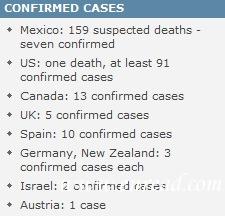
Officials put the number of suspected deaths from swine flu in Mexico at 159, although just seven deaths have been confirmed, with 26 infections positively5 tested.
Texas Governor Rick Perry said closing the US border with Mexico was an option, but added that taking that step now would be "a little premature6(过早)".
Since the virus emerged last week, it has also spread to Canada, Europe, Israel, and New Zealand.
Several countries have restricted travel to Mexico and many tour operators have cancelled holidays.
France will ask the European Union on Thursday to suspend all flights going to Mexico because of the flu outbreak, Health Minister Roselyne Bachelot said.
The WHO, however, says measures like travel bans are unlikely to prove effective.
'Social distancing'
In Spain, the government said the first person to contract swine flu without having travelled to Mexico was the boyfriend of a young woman who had recently returned from there.
Spanish Health Minister Trinidad Jimenez said such cases were to be expected.
In total, the number of confirmed cases in Spain rose from two to 10 on Wednesday. None of the patients is seriously ill.
In Mexico, the search for the source of the outbreak continues, with the focus on the vicinity(邻近,附近) of a pig farm in the eastern part of the country.
The Mexican government is urging against jumping to conclusions and is suggesting the possibility remains7 that the virus originated outside the country.
Schools across Mexico have closed, public gatherings8 are restricted and archaeological(考古遗址) sites have been placed off-limits.
Mexico City's chamber9 of commerce estimated restrictions10 in the city were costing businesses there at least 777 million pesos ($57m, £39m) per day.
WHO official Keiji Fukuda said other countries also needed to consider "social distancing" measures such as closing schools and delaying public meetings.
Meanwhile, Ghana has become the latest country to ban pork imports as a precaution against swine flu, though no cases have been found in the West African country.
Ms Chan, the WHO director, stressed on Wednesday that there was no danger from eating properly-cooked pork.
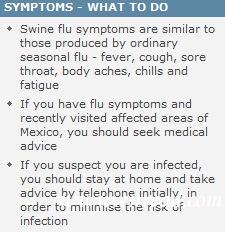
She advised hygiene11(卫生) measures such as hand-washing to prevent infection and said it was important "to maintain a level of calm".
 收听单词发音
 |
1
epidemic
|
|
| n.流行病;盛行;adj.流行性的,流传极广的 | |
参考例句: |
|
|
|
|
2
activate
|
|
| vt.使活动起来,使开始起作用 | |
参考例句: |
|
|
|
|
3
influenza
|
|
| n.流行性感冒,流感 | |
参考例句: |
|
|
|
|
4
vigilant
|
|
| adj.警觉的,警戒的,警惕的 | |
参考例句: |
|
|
|
|
5
positively
|
|
| adv.明确地,断然,坚决地;实在,确实 | |
参考例句: |
|
|
|
|
6
premature
|
|
| adj.比预期时间早的;不成熟的,仓促的 | |
参考例句: |
|
|
|
|
7
remains
|
|
| n.剩余物,残留物;遗体,遗迹 | |
参考例句: |
|
|
|
|
8
gatherings
|
|
| 聚集( gathering的名词复数 ); 收集; 采集; 搜集 | |
参考例句: |
|
|
|
|
9
chamber
|
|
| n.房间,寝室;会议厅;议院;会所 | |
参考例句: |
|
|
|
|
10
restrictions
|
|
| 约束( restriction的名词复数 ); 管制; 制约因素; 带限制性的条件(或规则) | |
参考例句: |
|
|
|
|
11
hygiene
|
|
| n.健康法,卫生学 (a.hygienic) | |
参考例句: |
|
|
|


