
Traces of planet collision found 行星相撞遗迹被发现
(单词翻译:单击)
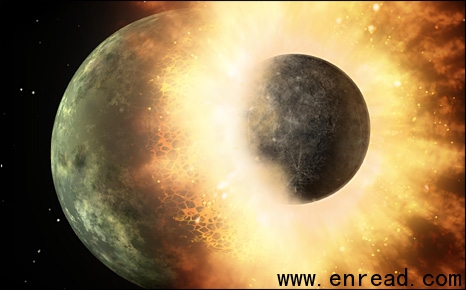
A Nasa space telescope has found evidence of a high-speed collision between two burgeoning1 planets orbiting a young star.
一架北约太空望远镜发现了围绕一个新恒星的两个快速发展的行星之间快速冲撞的迹象。
 astronomical2 terms, the collision happened relatively3 recently" width="466" border="0" src="http://www.enread.com/upimg/090812/4_005640_1.jpg" />
In astronomical terms, the collision happened relatively recently
Astronomers4 say the cosmic smash-up is similar to the one that formed our Moon some four billion years ago, when a Mars-sized object crashed into Earth.
In this case, two rocky bodies are thought to have slammed(猛然关上,砰然关上) into one another in the last few thousand years.
Details are to be published in the Astrophysical Journal.
The collision involved one object that was at least as big as our Moon and another that was at least as big as Mercury.
The impact destroyed the smaller body, vaporising(蒸发) huge amounts of rock and flinging(投掷,猛冲) plumes5 of hot lava6(熔岩,火山岩) into space.
Infrared7 detectors8(红外检测器) on Nasa's Spitzer Space Telescope were able to pick up the signatures of the vaporised(汽化) rock, along with fragments of hardened lava, known as tektites(玻陨石).
Melted glass
"This collision had to be huge and incredibly high-speed for rock to have been vaporised and melted," said lead author Carey M Lisse of the Johns Hopkins University Applied9 Physics Laboratory at Laurel in Maryland, US.
"This is a really rare and short-lived event, critical in the formation of Earth-like planets and moons. We're lucky to have witnessed one not long after it happened."
Dr Lisse and his team observed a star called HD 172555, which is about 12 million years old and situated10 about 100 light-years away in the far southern constellation11(星座,星群) Pavo (the Peacock).
The astronomers used a spectrograph(光谱摄制仪) instrument on Spitzer to look for the fingerprints12 of chemicals in the spectrum13 of light from the star.
The researchers identified large amounts of amorphous14 silica(非定晶硅) - melted glass.
Silica can be found on Earth in obsidian15 rocks and tektites.
Obsidian is black, shiny volcanic16 glass. Tektites are hardened chunks17 of lava thought to have formed when meteorites18 hit the Earth.
Large quantities of orbiting silicon19 monoxide(一氧化硅) gas were also detected, created when much of the rock was vaporised. In addition, the astronomers found rocky rubble20 that was probably flung out from the planetary wreck(失事,残骇).
The two bodies must have been travelling at a speed of at least 10km/s (about 22,400mph) relative to one other before the collision.
Rocky planets form and grow in size by colliding and sticking together. This process merges21 their cores and causes some of their surfaces to be shed.
Though things have settled down in the Solar System today, impacts still occur, as was observed last month when a small comet or asteroid22 struck Jupiter.
"The collision that formed our Moon would have been tremendous, enough to melt the surface of Earth," said co-author Geoff Bryden of Nasa's Jet Propulsion Laboratory (JPL) in Pasadena, California.
"Debris23 from the collision most likely settled into a disc around Earth that eventually coalesced24(合并,联合) to make the Moon. This is about the same scale of impact we're seeing with Spitzer."
"We don't know if a moon will form or not, but we know a large rocky body's surface was red hot, warped25 and melted."
The Spitzer telescope has witnessed the dusty aftermath of large impacts before, but did not find evidence for rock that had been melted and vaporised.
Instead, large amounts of dust, gravel26, and boulder(大圆石)-sized rubble were observed, indicating collisions that were slower-paced.
 收听单词发音
 |
1
burgeoning
|
|
| adj.迅速成长的,迅速发展的v.发芽,抽枝( burgeon的现在分词 );迅速发展;发(芽),抽(枝) | |
参考例句: |
|
|
|
|
2
astronomical
|
|
| adj.天文学的,(数字)极大的 | |
参考例句: |
|
|
|
|
3
relatively
|
|
| adv.比较...地,相对地 | |
参考例句: |
|
|
|
|
4
astronomers
|
|
| n.天文学者,天文学家( astronomer的名词复数 ) | |
参考例句: |
|
|
|
|
5
plumes
|
|
| 羽毛( plume的名词复数 ); 羽毛饰; 羽毛状物; 升上空中的羽状物 | |
参考例句: |
|
|
|
|
6
lava
|
|
| n.熔岩,火山岩 | |
参考例句: |
|
|
|
|
7
infrared
|
|
| adj./n.红外线(的) | |
参考例句: |
|
|
|
|
8
detectors
|
|
| 探测器( detector的名词复数 ) | |
参考例句: |
|
|
|
|
9
applied
|
|
| adj.应用的;v.应用,适用 | |
参考例句: |
|
|
|
|
10
situated
|
|
| adj.坐落在...的,处于某种境地的 | |
参考例句: |
|
|
|
|
11
constellation
|
|
| n.星座n.灿烂的一群 | |
参考例句: |
|
|
|
|
12
fingerprints
|
|
| n.指纹( fingerprint的名词复数 )v.指纹( fingerprint的第三人称单数 ) | |
参考例句: |
|
|
|
|
13
spectrum
|
|
| n.谱,光谱,频谱;范围,幅度,系列 | |
参考例句: |
|
|
|
|
14
amorphous
|
|
| adj.无定形的 | |
参考例句: |
|
|
|
|
15
obsidian
|
|
| n.黑曜石 | |
参考例句: |
|
|
|
|
16
volcanic
|
|
| adj.火山的;象火山的;由火山引起的 | |
参考例句: |
|
|
|
|
17
chunks
|
|
| 厚厚的一块( chunk的名词复数 ); (某物)相当大的数量或部分 | |
参考例句: |
|
|
|
|
18
meteorites
|
|
| n.陨星( meteorite的名词复数 ) | |
参考例句: |
|
|
|
|
19
silicon
|
|
| n.硅(旧名矽) | |
参考例句: |
|
|
|
|
20
rubble
|
|
| n.(一堆)碎石,瓦砾 | |
参考例句: |
|
|
|
|
21
merges
|
|
| (使)混合( merge的第三人称单数 ); 相融; 融入; 渐渐消失在某物中 | |
参考例句: |
|
|
|
|
22
asteroid
|
|
| n.小行星;海盘车(动物) | |
参考例句: |
|
|
|
|
23
debris
|
|
| n.瓦砾堆,废墟,碎片 | |
参考例句: |
|
|
|
|
24
coalesced
|
|
| v.联合,合并( coalesce的过去式和过去分词 ) | |
参考例句: |
|
|
|
|
25
warped
|
|
| adj.反常的;乖戾的;(变)弯曲的;变形的v.弄弯,变歪( warp的过去式和过去分词 );使(行为等)不合情理,使乖戾, | |
参考例句: |
|
|
|
|
26
gravel
|
|
| n.砂跞;砂砾层;结石 | |
参考例句: |
|
|
|
- 上一篇:Drink blamed for oral cancer rise 口腔癌患病率上升与饮酒有关
- 下一篇:Facebook in challenge to Google Facebook向Google叫板


