
'Alien scene' of tadpoles feast “外星般”的蝌蚪吃食景象
(单词翻译:单击)
"Alien-like" scenes of tadpoles1 feasting on eggs emerging from their mother have been caught on camera.
蝌蚪以它们母亲的卵当做食物的“外星人般”的景象被摄影机记录下来。
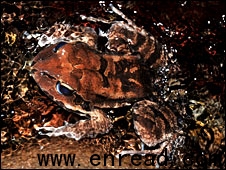
The team hopes to get the mountain chickens back into the wild
The footage marks the success of a captive breeding programme for the critically endangered mountain chicken frog, one of the world's largest frogs.
In April, 50 of the amphibian2(两栖类) giants were airlifted(空运) from Montserrat after a deadly fungus3(真菌,霉菌) swept through the island, devastating4 the population.
Now several breeding programmes are under way to save the frogs.
Once numbers have been boosted in captivity5, researchers hope to reintroduce the frogs back into the wild within the next two years.
Bizarre sight
The remarkable6 footage was recorded at the Durrell Wildlife Conservation Trust, in Jersey7, which took in 12 of the rescued frogs. Twenty-six others went to Parken Zoo in Sweden, and 12 are now housed in ZSL London Zoo.
So far, four pairs of mountain chicken frogs have started to breed - which could result in hundreds of frogs. And this has given researchers an insight into the way that these unusual amphibians8 care for their offspring(子孙,后代).
Professor John Fa, director of Durrell, said: "Mountain chickens have very peculiar9(奇怪的,古怪的) breeding habits because they form foam10(泡沫,水沫) nests in burrows11(洞穴) in the ground."
The females lay their eggs in these nests, which eventually hatch into tadpoles(蝌蚪). But as the nests are underground, food is scarce - so the frogs need to find a way to provide nutrition for their young.
Professor Fa explained: "In the case of mountain chickens, we have discovered that the female comes into the nest and starts laying a string of infertile12 eggs.
"We thought that the eggs would come out and drop to the bottom of the nest and then the tadpoles would start eating them. But the footage shows about 40 tadpoles congregating13(集合,聚集) around the female and eating the eggs as they come out of the female's body.
"Every now and again, the female uses her back legs to push the tadpoles away from her body so another set can come up and eat as much as they can."
He added: "It is really weird14 - it is an alien scene. This is the first time we have caught this on film."
The mountain chicken frog (Leptodactylus fallax) is one of the world's most threatened frogs. The frog is so called because its meat tastes like chicken.
It was once found on seven Caribbean Islands, but thanks to hunting and environmental pressures it is currently found only on Montserrat and Dominica.
Now, however, the deadly chytrid(壶菌) fungus, which has devastated16 amphibian populations around the globe, has also ravaged17(毁坏,破坏) Dominica's mountain chickens.
The fungus was first detected on the island in 2002, and within 15 months, 80% of the mountain chicken population had been obliterated18(阻塞).
Conservationists were extremely concerned when they found that the chytrid fungus had spread to Montserrat earlier this year, and was sweeping19 quickly through the last mountain chicken population.
The team made a decision to airlift some of the last healthy frogs and bring them into captivity in a bid to save the creatures from extinction20.
Professor Fa said: "Things are not going terribly well in Montserrat because chytrid has now infected the safe population - or at least the one we thought was safe."
The breeding success has offered scientists a ray of hope in an otherwise bleak21(萧瑟的,严寒的) situation, and they are now concentrating on increasing the frogs' numbers.
They hope to eventually release the captive mountain chickens back to their native home of Montserrat, and are currently looking for sites that are free of the deadly fungus.
But Professor Fa said: "If that doesn't work, if the area is infected, we will have to think again, and it could be that we take the animals to another island.
"Within a year or two we have to get these animals back to the wild. The longer you keep them in captivity, the more difficult it is for them to enjoy a life in the wild again."
 收听单词发音
 |
1
tadpoles
|
|
| n.蝌蚪( tadpole的名词复数 ) | |
参考例句: |
|
|
|
|
2
amphibian
|
|
| n.两栖动物;水陆两用飞机和车辆 | |
参考例句: |
|
|
|
|
3
fungus
|
|
| n.真菌,真菌类植物 | |
参考例句: |
|
|
|
|
4
devastating
|
|
| adj.毁灭性的,令人震惊的,强有力的 | |
参考例句: |
|
|
|
|
5
captivity
|
|
| n.囚禁;被俘;束缚 | |
参考例句: |
|
|
|
|
6
remarkable
|
|
| adj.显著的,异常的,非凡的,值得注意的 | |
参考例句: |
|
|
|
|
7
jersey
|
|
| n.运动衫 | |
参考例句: |
|
|
|
|
8
amphibians
|
|
| 两栖动物( amphibian的名词复数 ); 水陆两用车; 水旱两生植物; 水陆两用飞行器 | |
参考例句: |
|
|
|
|
9
peculiar
|
|
| adj.古怪的,异常的;特殊的,特有的 | |
参考例句: |
|
|
|
|
10
foam
|
|
| v./n.泡沫,起泡沫 | |
参考例句: |
|
|
|
|
11
burrows
|
|
| n.地洞( burrow的名词复数 )v.挖掘(洞穴),挖洞( burrow的第三人称单数 );翻寻 | |
参考例句: |
|
|
|
|
12
infertile
|
|
| adj.不孕的;不肥沃的,贫瘠的 | |
参考例句: |
|
|
|
|
13
congregating
|
|
| (使)集合,聚集( congregate的现在分词 ) | |
参考例句: |
|
|
|
|
14
weird
|
|
| adj.古怪的,离奇的;怪诞的,神秘而可怕的 | |
参考例句: |
|
|
|
|
15
killer
|
|
| n.杀人者,杀人犯,杀手,屠杀者 | |
参考例句: |
|
|
|
|
16
devastated
|
|
| v.彻底破坏( devastate的过去式和过去分词);摧毁;毁灭;在感情上(精神上、财务上等)压垮adj.毁坏的;极为震惊的 | |
参考例句: |
|
|
|
|
17
ravaged
|
|
| 毁坏( ravage的过去式和过去分词 ); 蹂躏; 劫掠; 抢劫 | |
参考例句: |
|
|
|
|
18
obliterated
|
|
| v.除去( obliterate的过去式和过去分词 );涂去;擦掉;彻底破坏或毁灭 | |
参考例句: |
|
|
|
|
19
sweeping
|
|
| adj.范围广大的,一扫无遗的 | |
参考例句: |
|
|
|
|
20
extinction
|
|
| n.熄灭,消亡,消灭,灭绝,绝种 | |
参考例句: |
|
|
|
|
21
bleak
|
|
| adj.(天气)阴冷的;凄凉的;暗淡的 | |
参考例句: |
|
|
|


