
Protests over Slovak language law 斯洛伐克新语言法遭抗议
(单词翻译:单击)
Thousands of ethnic1 Hungarians have demonstrated in Slovakia, to protest against a new law that limits the use of minority languages there.
数千匈牙利族人在斯洛伐克举行示威,抗议限制少数民族语言的一项新法律。
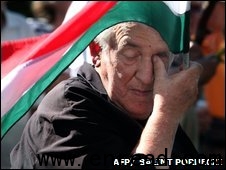
The law against minority languages in Slovakia is an emotive issue for many
Only Slovak can now be used in public offices, and in institutions(体系) like schools and hospitals.
Slovakia says the move is in accord with(一致于) European standards, but protestors argue it breaks international laws.
The Hungarian government says it has turned to international human rights organisations for help.
The Hungarian and Slovak prime ministers are due to meet next week, to try to defuse(放松,抚慰) worsening relations.
More than half a million ethnic Hungarians live in Slovakia, who regard the new law as the latest in a series of crackdowns by the Slovak government against their culture.
Peter Pazmany, of the opposition3 ethnic Hungarian Coalition4 Party in Slovakia, said the law: "makes no sense... [it] only creates tension between people who have lived peacefully side by side".
Fines
Anyone found to be regularly misusing5 the Slovak language in public office now faces a fine of up to $7,000 (£4,300), the equivalent of nearly a year's average pay in Slovakia, reports say.
The Organisation2 for Economic Co-operation and Development (OECD) has said the new law respects the rights of minorities, but has noted6 the concerns and risks related to its enforcement.
Ties between Slovakia and Hungary have long been strained over Bratislava's treatment of its ethnic Hungarians, who make up about 10% of the population.
For its part, Slovakia has previously7 voiced its distaste(不喜欢,厌恶) over what it sees as efforts by Budapest to promote Hungarian culture within its own borders.
The protests over the new law follow a row last week, when Slovakia barred the Hungarian president from making a controversial visit.
President Laszlo Solyom had planned to visit a part of Slovakia with a large ethnic Hungarian population, to unveil a statue of the first Hungarian king, Saint Stephen.
Slovakian Prime Minister Robert Fico said the plans were a provocation8(激怒,刺激) to his nation.
The BBC's Nick Thorpe in southern Slovakia says relations between the two countries are at the lowest point for many years.
Hungary once ruled Slovakia, within the then Austro-Hungarian empire, until the end of the First World War and the eventual9 break-up of those territories.
 收听单词发音
 |
1
ethnic
|
|
| adj.人种的,种族的,异教徒的 | |
参考例句: |
|
|
|
|
2
organisation
|
|
| n.组织,安排,团体,有机休 | |
参考例句: |
|
|
|
|
3
opposition
|
|
| n.反对,敌对 | |
参考例句: |
|
|
|
|
4
coalition
|
|
| n.结合体,同盟,结合,联合 | |
参考例句: |
|
|
|
|
5
misusing
|
|
| v.使用…不当( misuse的现在分词 );把…派作不正当的用途;虐待;滥用 | |
参考例句: |
|
|
|
|
6
noted
|
|
| adj.著名的,知名的 | |
参考例句: |
|
|
|
|
7
previously
|
|
| adv.以前,先前(地) | |
参考例句: |
|
|
|
|
8
provocation
|
|
| n.激怒,刺激,挑拨,挑衅的事物,激怒的原因 | |
参考例句: |
|
|
|
|
9
eventual
|
|
| adj.最后的,结局的,最终的 | |
参考例句: |
|
|
|
- 上一篇:Depressed teens 'face adult risk' 轻度抑郁青少年将来患病风险
- 下一篇:Voting change for best film Oscar 奥斯卡最佳影片投票系统更改


