
微金属粒子可影响改变DNA
(单词翻译:单击)
Tiny metal particles have been shown to cause changes to DNA1 across a cellular2 barrier - without having to cross it.
微小的金属粒子可以隔着细胞屏障改变DNA,而不必穿过它。
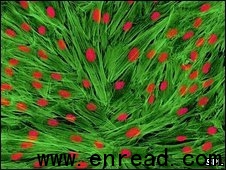 illuminate3 the cell signalling" width="226" height="170" src="http://www.enread.com/upimg/091109/4_065939_1.jpg" />
The study used fibroblast cells to illuminate the cell signalling
The nanometre(毫微米) and micrometre(微米) scale particles resulted in an increase of damage to DNA across the barrier via a never-before-seen cell signal process.
Reporting in Nature Nanotechnology, the researchers say the mechanism4 could be both a risk and an opportunity.
They say the preliminary result(预备结果) is relevant as more medical therapies rely on small-scale particles.
For instance, nanoparticle-based approaches are being considered for use to improve MRI images or direct the delivery of cancer drugs.
However, they concede their model system is far simpler than the human body, where the effects will be harder to unpick.
As yet, the researchers are not even certain of the mechanism by which the signalling molecules5 cause damage to DNA.
Communication skills
The team studied the effects of particles made from cobalt(钴) and chromium(铬), either 30 billionths of a metre or four millionths of a metre across.
These metals are used in implants7(植入体) such as artificial hips8 or knees.
They grew a thin, artificial membrane9(人工膜) from human cells and placed the particles on the membrane. Beneath it, they placed fibroblast cells(纤维母细胞), which in the body help to form connective tissue.
Although the team showed that the particles had not crossed the membrane, the fibroblast cells beneath were shown to have about 10 times as many damage sites in their DNA than the case in which no particles were used.
Gevdeep Bhabra, lead author on the research from the Bristol Implant6 Research Centre, explained that cells in close contact are known to exhibit cell-to-cell communication through structures known as gap junctions10 and hemichannels.
"We used a variety of chemicals to block this cell-to-cell signalling and found that in the presence of these blockers, the damage we were seeing was completely prevented," he said.
The team stressed that the concentrations of the particles were thousands of times higher than would be found in the human body, for instance from wear and tear(磨损,折磨) on implants.
As a result, there is no reason to believe that implants pose a risk via the signalling mechanism.
However, its discovery suggests that there is much work to be done to establish if the mechanism that appears to be responsible for the DNA damage is limited to those materials, or can occur in the presence of other materials of a similar size.
That issue is of particular importance as more therapeutic11 and imaging approaches begin to make use of nano-scale materials.
Ashley Blom, head of orthopaedic surgery(矫正外科,骨科) at the University of Bristol, explained that although the signalling could pose a future risk, once understood it could be put to good therapeutic use.
"If the barriers in the human body do work in this way, the first exciting thing is: can we deliver novel therapies across barriers without having to cross them?
"For example, if you have a condition that affects the brain, maybe we could treat you with something that doesn't cross the blood-brain barrier, that does not come in contact with the brain."
 收听单词发音
 |
1
DNA
|
|
| (缩)deoxyribonucleic acid 脱氧核糖核酸 | |
参考例句: |
|
|
|
|
2
cellular
|
|
| adj.移动的;细胞的,由细胞组成的 | |
参考例句: |
|
|
|
|
3
illuminate
|
|
| vt.照亮,照明;用灯光装饰;说明,阐释 | |
参考例句: |
|
|
|
|
4
mechanism
|
|
| n.机械装置;机构,结构 | |
参考例句: |
|
|
|
|
5
molecules
|
|
| 分子( molecule的名词复数 ) | |
参考例句: |
|
|
|
|
6
implant
|
|
| vt.注入,植入,灌输 | |
参考例句: |
|
|
|
|
7
implants
|
|
| n.(植入身体中的)移植物( implant的名词复数 ) | |
参考例句: |
|
|
|
|
8
hips
|
|
| abbr.high impact polystyrene 高冲击强度聚苯乙烯,耐冲性聚苯乙烯n.臀部( hip的名词复数 );[建筑学]屋脊;臀围(尺寸);臀部…的 | |
参考例句: |
|
|
|
|
9
membrane
|
|
| n.薄膜,膜皮,羊皮纸 | |
参考例句: |
|
|
|
|
10
junctions
|
|
| 联结点( junction的名词复数 ); 会合点; (公路或铁路的)交叉路口; (电缆等的)主结点 | |
参考例句: |
|
|
|
|
11
therapeutic
|
|
| adj.治疗的,起治疗作用的;对身心健康有益的 | |
参考例句: |
|
|
|
- 上一篇:驯马基因组被成功解码
- 下一篇:月球上发现“数量可观”的水源


