
以色列器官捐献人将享受器官移植优先权
(单词翻译:单击)
Israel is to become the first country to give donor1 card carriers a legal right to priority treatment if they should require an organ transplant.
以色列成为第一个当器官捐献卡持有者需要器官移植时,给予其优先治疗权的国家。
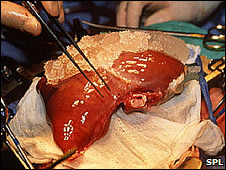
Organs for transplant are in short supply
The law has been changed to try to boost donation rates, as there is a shortage for organs for donation.
Partners and close relatives of those with signed donor cards will also move up the queue, The Lancet medical journal reports.
Critics say patients should be treated on the basis of clinical need.
Writing in The Lancet, Professor Jacob Lavee, of the Sheba Medical Centre, one of the leading advocates拥护者,提倡者 for the reform, describes Israel's organ donation statistics as "grim".
Only one in 10 adults in Israel carries a donor card. In the UK about one in four adults is on the organ donor register.
In 2006, the Israel National Transplant Council established a special committee, including ethicists, philosophers, religious representatives and transplant surgeons to review the problem.
Their proposal to bring in non-medical criteria2标准,条件 for organ allocation分配,配置 required legislation by the Israeli parliament.
Under the planned point-based system, people who have signed a donor card will be given priority for a transplant.
Their partners and other close relatives will also qualify.
However, there will be no preference for live donors3 who give to a chosen recipient4 rather than the wider waiting list.
Urgent cases
Patients requiring an urgent transplant because of their serious condition will continue to have priority, regardless of the new points-scheme.
But if there are two people in this situation who are equally suitable for a donated organ, the priority system will come into play.
Professor Lavee said the new policy "provides an incentive5动机,刺激 for individuals to agree to help each other".
But he acknowledged that it violated the principle of "true altruism利他主义", and the "ideal" of care being provided solely7 according to medical need.
However, he concluded that this was a price worth paying.
He said: "If this policy results in the procurement8获得,采购 of more organs for transplantation, then it promotes a different but nonetheless尽管如此,但是 important goal of medicine - achievement of maximum health."
Dr Vivienne Nathanson, head of science and ethics10 at the British Medical Association, voiced strong misgivings.
"We would have serious concerns about a system that would move away from treating patients on the basis of基于,根据 clinical need," she said.
"Once you start prioritising certain groups, for example those that sign up to the organ register, patients who are really sick and in danger of dying if they don't receive an organ may end up being pushed to the back of the queue".
And Mubeen Bhutta, Policy Manager at the British Heart Foundation, said: "This interesting new law in Israel highlights the challenges facing countries around the world seeking to increase the availability of donated organs.
"However, it is important that donated organs are available for those who need them most.
 收听单词发音
 |
1
donor
|
|
| n.捐献者;赠送人;(组织、器官等的)供体 | |
参考例句: |
|
|
|
|
2
criteria
|
|
| n.标准 | |
参考例句: |
|
|
|
|
3
donors
|
|
| n.捐赠者( donor的名词复数 );献血者;捐血者;器官捐献者 | |
参考例句: |
|
|
|
|
4
recipient
|
|
| a.接受的,感受性强的 n.接受者,感受者,容器 | |
参考例句: |
|
|
|
|
5
incentive
|
|
| n.刺激;动力;鼓励;诱因;动机 | |
参考例句: |
|
|
|
|
6
altruism
|
|
| n.利他主义,不自私 | |
参考例句: |
|
|
|
|
7
solely
|
|
| adv.仅仅,唯一地 | |
参考例句: |
|
|
|
|
8
procurement
|
|
| n.采购;获得 | |
参考例句: |
|
|
|
|
9
misgivings
|
|
| n.疑虑,担忧,害怕;疑虑,担心,恐惧( misgiving的名词复数 );疑惧 | |
参考例句: |
|
|
|
|
10
ethics
|
|
| n.伦理学;伦理观,道德标准 | |
参考例句: |
|
|
|
- 上一篇:利比亚人权有“有限提高”
- 下一篇:东非干旱导致数百万生命受到威胁


