
午夜零食严重损害牙齿
(单词翻译:单击)
Eating food in the middle of the night can seriously damage your teeth, experts warn.
专家警告,在午夜吃东西可严重损伤牙齿。
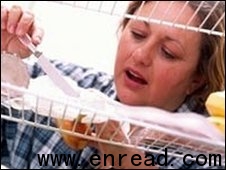
Midnight snacks may stick to the teeth for longer, experts suspect
Researchers have found midnight snacking ups the risk of tooth loss, regardless of the type of food that is eaten.
The Danish investigators1 blame changes in saliva2(唾液) flow - it tends to dry up at night.
Enough saliva is important to remove food debris(碎片,残骸) from the mouth, they explain in Eating Behaviours journal.
Working with colleagues from the US, the team at Copenhagen University examined the medical records of 2,217 Danes already enrolled4 in a medical study.
Of these 173, or 8%, could be classed as nocturnal(夜间的) eaters - meaning they consumed a quarter or more of their daily calories after dinner or would wake up in the middle of the night at least twice a week for a little moonlight snack.
When the researchers tracked what happened to all of the study participants over a period of six years, a significant finding emerged.
The nocturnal eaters ended up losing more teeth, even after accounting5 for other factors such as age, smoking and sugar/carbohydrate(碳水化合物) consumption.
While dentists may not be able to stop their patients feasting in the middle of the night, Dr Jennifer Lundgren and colleagues say they should make them aware of the associated risks.
"Practitioners6 should be aware of the oral health implications(含义,启示) of nocturnal eating, increase screening and oral health education efforts among nocturnal eaters and make treatment referrals when appropriate(适当的) ," they say.
Professor Damien Walmsley, scientific adviser7 to the British Dental Association, said: "Eating at night, when the mouth is driest and any food remains8 in the mouth longer, accentuates9(强调) the impact of consuming sugary and acidic(酸性的) food and drinks.
"To minimise damage, it is important to brush teeth twice a day with fluoride(氟化物) toothpaste, with one of those brushes coming immediately before bedtime.
"Where possible, consume only water for at least an hour before the final brush of the day."
 收听单词发音
 |
1
investigators
|
|
| n.调查者,审查者( investigator的名词复数 ) | |
参考例句: |
|
|
|
|
2
saliva
|
|
| n.唾液,口水 | |
参考例句: |
|
|
|
|
3
nibbles
|
|
| vt.& vi.啃,一点一点地咬(nibble的第三人称单数形式) | |
参考例句: |
|
|
|
|
4
enrolled
|
|
| adj.入学登记了的v.[亦作enrol]( enroll的过去式和过去分词 );登记,招收,使入伍(或入会、入学等),参加,成为成员;记入名册;卷起,包起 | |
参考例句: |
|
|
|
|
5
accounting
|
|
| n.会计,会计学,借贷对照表 | |
参考例句: |
|
|
|
|
6
practitioners
|
|
| n.习艺者,实习者( practitioner的名词复数 );从业者(尤指医师) | |
参考例句: |
|
|
|
|
7
adviser
|
|
| n.劝告者,顾问 | |
参考例句: |
|
|
|
|
8
remains
|
|
| n.剩余物,残留物;遗体,遗迹 | |
参考例句: |
|
|
|
|
9
accentuates
|
|
| v.重读( accentuate的第三人称单数 );使突出;使恶化;加重音符号于 | |
参考例句: |
|
|
|
- 上一篇:乳腺癌疫苗将来有望研制成功
- 下一篇:“火星500天”计划开始封闭式训练


